Comparisons
Oblong vs Square, Round & Heart Face Shapes: The Differences
How an oblong face differs from square, round and heart shapes, feature by feature, plus what to do when your proportions sit between two categories.
By Ayla Willow ·
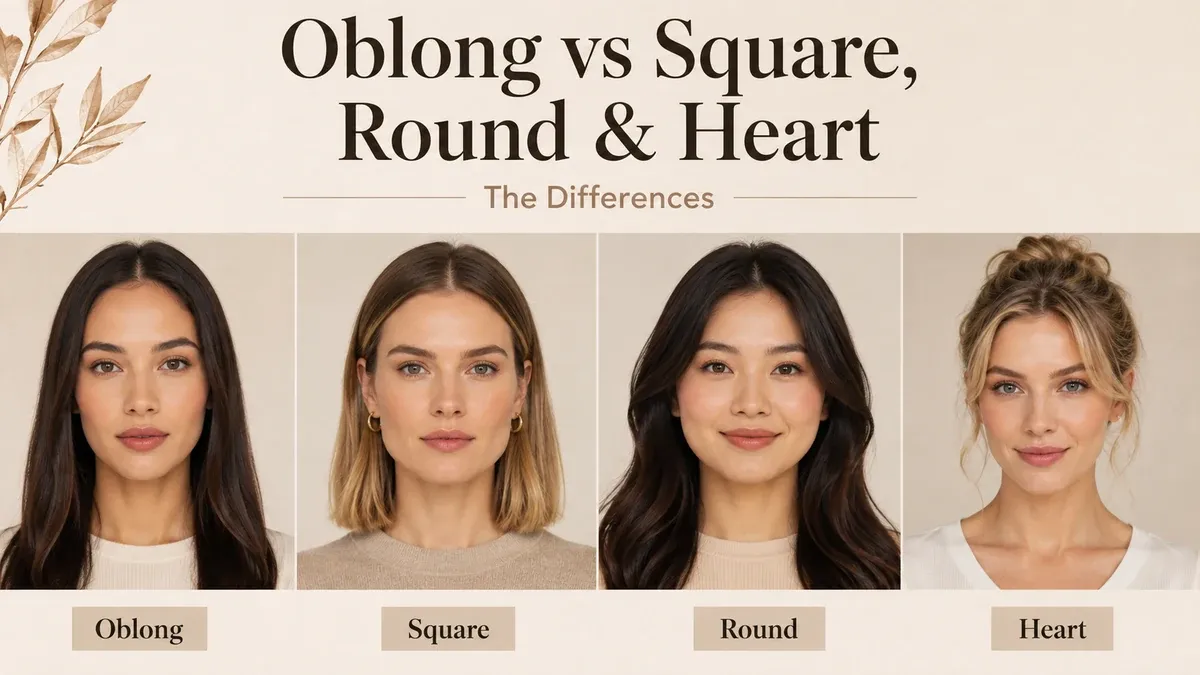
The fastest way to separate these four is to answer two questions in order. Is your face clearly longer than it is wide, or close to equal? Then, which part of your face is widest, and is your jaw angular or curved?
Oblong is long with three similar widths and a soft jaw. Square is close to equal in length and width with an angular jaw. Round is close to equal with the cheeks widest and everything soft. Heart is long-ish with the forehead widest, tapering to a narrow chin.
Those two questions resolve most cases. The rest of this article is for the ones they do not.
Why Are Oblong, Square, Round and Heart Faces Confused?
Each pair shares one obvious feature, which is exactly what makes them easy to mix up.
Oblong and square can both have a forehead and jaw of similar width, so a face that looks “straight down the sides” could be either. Oblong and round can both have a soft, curved jaw with no visible corners. Oblong and heart can both be longer than they are wide.
Because each comparison hinges on a different feature, comparing all four at once tends to produce confusion rather than an answer. It works better to take them one at a time, which is how the sections below are arranged.
The Five Features That Separate These Face Shapes
Five things separate these shapes. It helps to know what each one is before comparing.
Face length runs from the hairline at the centre of the forehead straight down to the base of the chin.
Forehead width is measured across the widest part of the forehead, usually about halfway between the brows and the hairline.
Cheekbone width is measured straight across from the outer corner of one eye to the outer corner of the other.
Jaw width is measured across the face at the widest point of the jaw, below the ears.
Jaw shape is not a measurement. It is whether the corners of your jaw form a visible angle or a continuous curve.
The four measurements tell you the proportions. The fifth tells you which of two shapes with the same proportions you are looking at. How to measure your face shape covers taking each one properly, including the mistakes that shift the result.
Oblong vs Square
The shared feature: the forehead and jaw can measure close to the same width on both, so the sides of the face look relatively parallel.
The difference that decides it: proportion first, then the jaw.
A square face is roughly as wide as it is long. Divide length by average width and the answer sits close to one. An oblong face is clearly longer, and the same calculation gives a noticeably higher number.
The jaw then confirms it. A square jaw has definite corners: the line from ear to chin changes direction sharply, and you can see the angle. An oblong jaw curves. Run a finger from below your ear to your chin and notice whether it turns a corner or follows a continuous arc.
Where the confusion comes from: photographs. A camera close to the face exaggerates whatever is nearest it, and a slightly downward angle shortens the apparent length of a face. A long face photographed from above can read as square. This is why the mirror and a tape measure beat a selfie for this particular question.
One more source of confusion: a long face with an angular jaw is usually classified as rectangle rather than oblong. If your proportions are long and your jaw has hard corners, that is the label to look at. Oblong vs rectangle covers the distinction in full.
Oblong vs Round
The shared feature: a soft, curved jawline with no visible corners. Neither shape has an angular jaw, so jaw softness cannot tell them apart.
The difference that decides it: length, and where the widest point sits.
A round face measures close to the same in length and width. An oblong face is clearly longer than it is wide. This is the primary separation and it is usually obvious once measured, even when it is not obvious in the mirror.
The widest point adds confirmation. A round face is widest at the cheeks, with the forehead and jaw both narrower, producing a curved outline that comes in at the top and bottom. An oblong face has forehead, cheekbones and jaw sitting close together, so the sides run more nearly parallel.
Where the confusion comes from: cheek fullness. Someone with an oblong bone structure and full cheeks may look round in a photograph while measuring long. Weight change, age and even time of day can alter apparent cheek fullness without altering the underlying proportion. The tape measure sees through this; the mirror often does not.
A quick check: pull your hair back and look straight on. If the outline of your face comes in noticeably at both the temples and the jaw, leaving the cheeks as a clear widest point, that is round. If the sides run down without much narrowing, that is oblong.
Oblong vs Heart
The shared feature: both are longer than they are wide, so overall proportion does not separate them.
The difference that decides it: the top-to-bottom pattern of the three widths.
A heart-shaped face is widest at the forehead. The width then reduces through the cheekbones and reduces again toward a narrow, often pointed chin. The outline tapers as it descends.
An oblong face keeps its three widths close together. The forehead, cheekbones and jaw measure within a small range of one another, so the outline stays roughly the same width from top to bottom before rounding off at the chin.
The chin adds the final confirmation. A heart-shaped face usually ends in a defined point or a narrow, tapered chin. An oblong chin is rounded, or only lightly tapered, and is noticeably wider than a heart-shaped one at the same face length.
Where the confusion comes from: hairlines. A widow’s peak makes the forehead look narrower than it measures and can make a heart-shaped face read as oblong. A high, straight hairline does the opposite. This is why the forehead measurement is taken across the widest part of the forehead rather than at the hairline itself.
A second source: long hair worn down covers the sides of the face and hides the taper. Almost everyone should pull their hair back before judging this pair.
Oblong, Square, Round and Heart Faces Side by Side
| Feature | Oblong | Square | Round | Heart |
|---|---|---|---|---|
| Length vs width | Clearly longer than wide | Roughly equal | Roughly equal | Longer than wide |
| Widest point | No strong widest point | Even top to bottom | Cheekbones | Forehead |
| Forehead width | Similar to cheeks and jaw | Similar to cheeks and jaw | Narrower than cheeks | Widest of the three |
| Cheekbone width | Similar to forehead and jaw | Similar to forehead and jaw | Widest of the three | Narrower than forehead |
| Jaw width | Similar to forehead | Similar to forehead | Narrower than cheeks | Narrowest of the three |
| Jaw shape | Soft, curved corners | Angular, visible corners | Soft, fully curved | Narrow, tapering |
| Chin | Rounded or lightly tapered | Squared or flat | Rounded | Pointed or narrow |
| Overall outline | Long, sides near parallel | Compact, straight-sided | Compact, circular | Wide at top, narrow at base |
The table is a summary, not a test. Reading down a single column and matching every row is unusual. Most people match a column on four or five rows and differ on the rest, which is the normal result rather than a failure.
How to Decide Your Face Shape One Feature at a Time
Comparing everything simultaneously is what makes this hard. Comparing one feature at a time is much easier.
- Pull your hair completely back and stand square to a mirror in even light. Hair over the temples or jaw makes this unreliable, and side lighting creates shadows that read as bone structure.
- Settle length versus width first. Measure face length and the three widths, then divide the length by the average of the three widths. A result close to one points to square or round. A clearly higher result points to oblong, rectangle or heart. This single step removes half the options.
- Find your widest measurement. If it is the cheekbones by a clear margin, look at round. If it is the forehead by a clear margin, look at heart. If the three are close together, look at oblong, square or rectangle depending on step two.
- Read the jaw. Trace from below your ear to your chin. A visible corner points to square or rectangle. A continuous curve points to oblong or round.
- Read the chin last. Rounded and reasonably wide fits oblong. Squared or flat fits square. Narrow and pointed fits heart.
- Repeat the measurements once more on a different day. Small differences in tape placement move borderline results, and a second reading tells you whether your first was stable.
If you would rather have the arithmetic done for you, the face shape detector scores all seven shapes from a photo, your camera or the four measurements, and shows the numbers it used so you can see how close the runner-up was.
Four Mistakes That Lead to the Wrong Face Shape
Most wrong answers come from the same handful of causes rather than from genuinely ambiguous faces.
Judging from a phone photo. A front camera held at arm’s length sits close enough to distort proportions, and the angle is rarely level with your eyes. Held slightly high it shortens the face; held slightly low it lengthens it. If you use a photo, take it from a metre or more away with the camera at eye height.
Leaving hair in the frame. Hair covering the temples narrows the apparent forehead, and hair falling past the jaw hides the jaw entirely. Both push a reading toward the wrong shape, and both are easy to forget because it is how you normally see yourself.
Measuring the forehead at the hairline. The forehead measurement is taken across the widest part of the forehead, not along the hairline. Hairlines recede, sit low, or come to a peak, and none of that changes the underlying bone width. Using the hairline is the single most common measurement error in this whole exercise.
Reading the jaw in profile. Jaw angle looks much sharper from the side than it does head on, so a profile view tends to push people toward square and rectangle. Because face shape is a straight-on impression, it should be judged straight on.
Fixing these four usually resolves a reading that seemed to fit two shapes equally.
Borderline and Hybrid Faces Are Normal
Face-shape categories are a practical framework for making styling decisions. They are not biological classes with fixed boundaries, and no threshold exists that everyone agrees on.
In practice, this means a few things worth knowing.
Many faces sit between two shapes. A face that is long but only moderately so, with a slight taper toward the chin, sits between oblong and oval. A long face with a partly angular jaw sits between oblong and rectangle. Neither is a measurement error.
The runner-up matters. If a face scores high on oblong and nearly as high on heart, styling advice from both is worth reading. The proportions really do carry features of both, so both sets of guidance contain something useful.
Small measurement differences move the answer. A few millimetres of difference in where you place the tape across your forehead can change which shape comes out on top for a borderline face. That is a property of the categories, not a flaw in your measuring.
Faces change. Weight, age and even hairstyle alter the proportions people perceive, and to some extent the ones you measure. A classification from five years ago may not describe you now.
Anyone who tells you there is a precise ratio that definitively assigns a face to one category is describing a convention as though it were a fact. Different charts use different cut-offs, and they disagree with each other.
How Styling Differs for Oblong, Square, Round and Heart Faces
The point of the exercise is deciding what to do next, and the four shapes pull in genuinely different directions.
An oblong face gains from horizontal emphasis at eye and jaw level: fringes that shorten the forehead, layers or volume at the cheekbone, frames with real width and depth, and accessories that are wider than they are long.
A square face is usually approached with softening rather than widening, since width is already there. A round face is often approached with length and definition, which is close to the opposite of oblong advice. A heart-shaped face is usually approached by adding a little width low down to balance a wider forehead.
Which is why getting the label roughly right matters more than getting it exactly right. Oblong and rectangle guidance overlaps almost completely. Oblong and round guidance does not, and following the wrong one works against you.
If oblong is where you landed, hairstyles for men and hairstyles for women cover the cuts, and glasses for men and glasses for women cover frames.
Summary: Telling Oblong From Square, Round and Heart
Length versus width separates oblong and heart from square and round. The widest point separates round (cheeks) and heart (forehead) from oblong and square (all similar). Jaw shape separates square (angular) from oblong (curved). The chin confirms it.
Work through those in order, expect to land between two shapes rather than squarely inside one, and treat the result as a starting point for styling decisions rather than a fact about your face.
Frequently Asked Questions
Short answers to the questions that come up most often on this topic.
What is the difference between an oblong and a square face?
How do I know if my face is oblong or round?
Can a face be both oblong and heart-shaped?
Which measurement matters most when telling face shapes apart?
What if my measurements do not match any one shape?