Eyewear
Sunglasses for Women With an Oblong Face Shape
Sunglasses that suit an oblong face on women: oversized cat-eyes, round frames, bold rectangles and wide aviators, plus sizing and lens tint advice.
By Ayla Willow ·
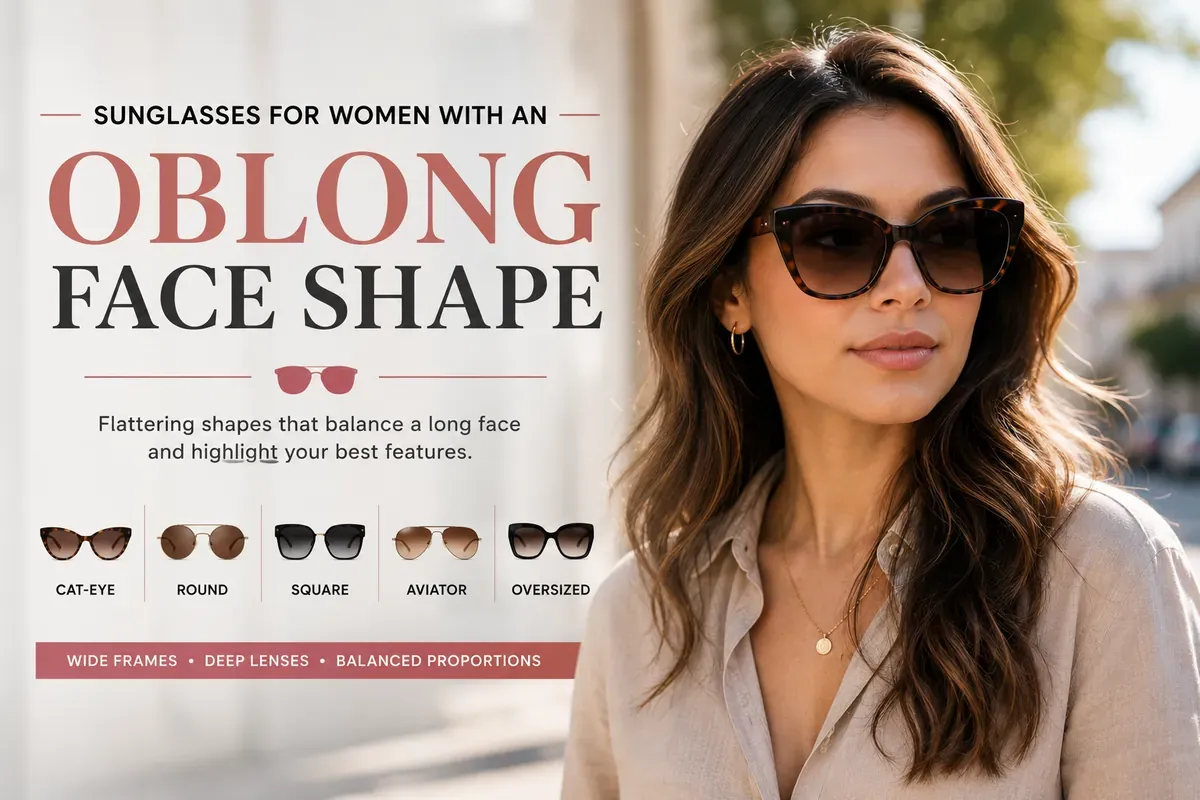
Sunglasses are larger than most prescription frames, which means they cover more of the face and carry more influence over how its proportions read. On an oblong face that scale is useful: there is more frame doing the work and more mid-face to cover.
The short answer: choose wide, deep frames. Oversized cat-eyes, large round frames, bold rectangles and wide squared aviators all balance a long face. Narrow frames, very shallow lenses and small rimless styles do the least, because they add almost no horizontal line.
What Do Sunglasses Do for an Oblong Face?
Sunglasses change an oblong face in three ways: the frame draws a horizontal line at eye level, the lens covers part of the mid-face, and a dark tint makes both effects stronger.
An oblong face has more length than width, with forehead, cheekbone and jaw measuring close to one another. There is no strong widest point to work with. The face shape detector on the homepage will show you where your own measurements land.
A frame changes that in two ways.
It draws a horizontal line at eye level. The wider and more visible that line, the more it interrupts the run from hairline to chin.
It covers vertical space. A deep lens shortens the visible distance between brow and cheek. A shallow one leaves that distance open.
Tint adds a third factor that clear glasses do not have. A dark lens reads as a solid block, which makes the frame area more visible and strengthens the horizontal. It is why a dark oversized pair changes your proportions more noticeably than a lightly tinted pair of the same shape.
Which Sunglasses Shapes Suit an Oblong Face on Women?
Six sunglasses shapes suit an oblong face on women: oversized cat-eyes, large round frames, bold rectangles, wide squared aviators, oversized squares, and shield or wraparound styles.
Oversized Cat-Eye
An oversized cat-eye is one of the most effective sunglasses shapes for an oblong face. The upswept outer corners pull the eye outward and slightly upward, adding width at exactly eye level, and the oversized versions bring the depth that makes the shape work on a long face.
The distinction worth understanding is between a slim retro cat-eye and a full one. The slim version has the right line but very little frame, so it does much less. The fuller version does both jobs at once.
Large Round Frames
Round frames put their widest point level with the pupil, and their curve contrasts with a long, comparatively straight face. That contrast is part of why they read well here.
Size decides whether it works. A generously sized round frame spans enough of the face to matter; a small circular lens sits in the middle of a long face without covering much of it.
Bold Rectangular Frames
Bold rectangular sunglasses are the most straightforward choice for an oblong face, and the easiest to shop for. A rectangle with a strong straight top line and enough lens depth delivers the horizontal without any styling risk. Thicker acetate reads stronger than fine metal, because the visible mass of the frame reinforces the line.
Wide Squared Aviators
Aviators work on a long face when they are large and squared off at the lower edge, rather than tapering to a teardrop point. The double bridge adds a second horizontal element at the top, and the typical size means the frame spans most of the face.
A classic narrow teardrop is the version to skip. The lens narrows toward a downward point, which follows the direction the face already runs.
Oversized Square
If you want maximum coverage, a large square frame fills more of the mid-face than any other shape here. It suits stronger features and reads as deliberate rather than neutral. The thing to watch is the lower edge: it should sit above the cheekbone rather than resting on it.
Shield and Wraparound Styles
Shield and wraparound sunglasses span the full width of the face by design, which suits an oblong shape well, and they give the most coverage of anything on this list. The trade-off is that they read as sports or fashion-statement eyewear rather than everyday wear, so it depends what you want the pair for.
Sunglasses Shapes for an Oblong Face Compared
| Shape | Where the width sits | Lens depth | Reads as | Best for |
|---|---|---|---|---|
| Oversized cat-eye | Outer corners, upswept | Medium to deep | Defined, classic | Width and lift together |
| Large round | Level with the eye | Medium to deep | Soft, distinctive | Contrast with a long straight face |
| Bold rectangle | Straight top line | Medium | Neutral, everyday | Easy shopping, any outfit |
| Squared aviator | Double bridge, flat top | Deep | Relaxed, larger scale | Aviator look with balance |
| Oversized square | Straight, plus coverage | Deep | Bold, statement | Maximum coverage |
| Shield or wraparound | Full face width | Deep | Sporty, technical | Coverage first |
What Size Sunglasses Suit an Oblong Face?
Frames print three numbers inside the temple arm, usually in the form 55-18-140.
- Lens width is the first number in millimetres. Larger figures mean more horizontal coverage, which is what you want here.
- Bridge width is the second, the gap between lenses. It governs how high the frame sits and whether it slides.
- Temple length is the third, affecting only how the arms sit behind your ears.
- Lens height is rarely printed. Measure it on a pair you own; around 40mm or more keeps a frame from reading as a band across a long face.
- Total frame width decides proportion. Measure your own face at the temples with a soft tape, then match that figure or exceed it slightly.
The mirror test is quicker: looking straight on, the frame should reach roughly to the outer edge of your face, with no cheek visible at either side of the lenses. The lower edge should clear your cheekbone rather than sit on it.
How Lens Tint and Frame Colour Change the Effect
Tint is mostly about function, but it changes the look.
Dark solid tints in grey, brown or green make the lens read as a block and strengthen the horizontal. Gradient tints, darker at the top and lighter at the bottom, keep the strong line at brow level while letting the eye show through, which is a useful middle ground. Very light or clear-tinted fashion lenses soften the effect considerably.
Frame colour works the same way. A frame that contrasts with your hair and skin stands out more and reads stronger. A frame close to your skin tone blends and does less.
Temple detail is a smaller lever pointing in the same direction: colour, texture or extra width on the arms draws attention to the sides of the head rather than the centre.
The functional point matters more than any of this. Look for UV400 or a clear statement of 100 percent UVA and UVB protection on the label. Tint darkness and UV filtering are separate specifications, and a dark lens without UV protection lets your pupils open wider behind it.
How Big Can Oversized Sunglasses Go on an Oblong Face?
Oversized frames suit an oblong face, but there is a point where extra size stops helping. Knowing where it sits saves a lot of returns.
The two checks that matter are both about your own face rather than the frame. The outer edge of the frame should end close to the edge of your face, not hang past it; a frame that overhangs makes the face look smaller inside it rather than wider. And the lower rim should clear your cheekbone, so the frame stays put when you smile and does not press marks into your skin.
Weight is the third consideration. Large acetate frames sit heavier on the nose, and a pair that slides down every ten minutes will not get worn regardless of how well the shape suits you. Adjustable nose pads or a slightly narrower bridge usually solve it.
Which Sunglasses Lengthen an Oblong Face?
Narrow frames, very shallow lenses, small round or rimless frames, teardrop aviators and tall narrow frames do the least for an oblong face. None of these is an error; each one simply does less, or runs in the same direction the face already goes.
Narrow frames. Anything noticeably narrower than your face leaves cheek showing at the sides and concentrates everything in the centre, which lengthens the look.
Very shallow lenses. Slim low-profile styles read as a thin stripe on a long face. Depth is usually what a frame you like is missing.
Small round or small rimless frames. They add almost no horizontal line. If you want the frame to work with your proportions, these do the least.
Classic narrow teardrop aviators. The downward taper points the same way the face runs.
Frames that are tall but narrow. Oversized helps, but a frame that gains size mostly in height adds vertical rather than horizontal.
Frames sitting high on the nose. A visible gap between eyebrow and top rim breaks the band that makes a frame effective.
How to Try On Sunglasses for an Oblong Face
- Look straight on first. Check the frame spans your face width and that no cheek shows at either side.
- Check the brow line. Your eyebrows should sit at or just behind the top of the frame rather than well above it.
- Check the lower edge. It should clear your cheekbone, so the frame does not lift when you smile.
- Look down. If the frame slides, the bridge is too wide for your nose whatever the shape looks like.
- Try them with your hair as you normally wear it. A fringe or hair pulled back changes how a frame reads.
- Step outside if you can. Tint looks very different in daylight than under shop lighting.
- Try one size up and one down. The same style number fits differently between brands.
How Sunglasses Work With Hair, Brows and Makeup
Sunglasses sit on the same face as everything else, and they read best when the rest agrees with them.
A fringe shortens the forehead directly above the frame, reinforcing the effect. Hairstyles for women with an oblong face covers the cuts that pair well.
Brow shape sits just above the frame. A flatter brow with a softer arch keeps the eye moving across the face rather than up it.
Blush placed on the apples of the cheeks and blended outward works in the same direction. See makeup for women with an oblong face.
If you also wear a prescription, the same principles apply at a smaller scale in glasses for women with an oblong face.
Are These Sunglasses Rules Mandatory for an Oblong Face?
No. These sunglasses guidelines describe proportion, not corrections. An oblong face is a normal, common face shape and nothing here suggests otherwise. Sunglasses also do a job beyond appearance, and protection and coverage matter more than shape does.
If a pair you love breaks every guideline here, wear it. How you feel in something reads more clearly than proportion. Use this to understand why one pair works better on you than another, then choose for yourself.
Frequently Asked Questions
Short answers to the questions that come up most often on this topic.
What sunglasses suit a woman with a long face?
Do oversized sunglasses suit an oblong face?
Are cat-eye sunglasses good for a long face?
What lens width should I look for?
Does lens tint change how the frame looks?