Accessories
Best Earrings for an Oblong Face Shape and What to Skip
How earring width, length and volume change the proportions people see on a long face, which styles add width, and how to wear long drops without lengthening.
By Ayla Willow ·
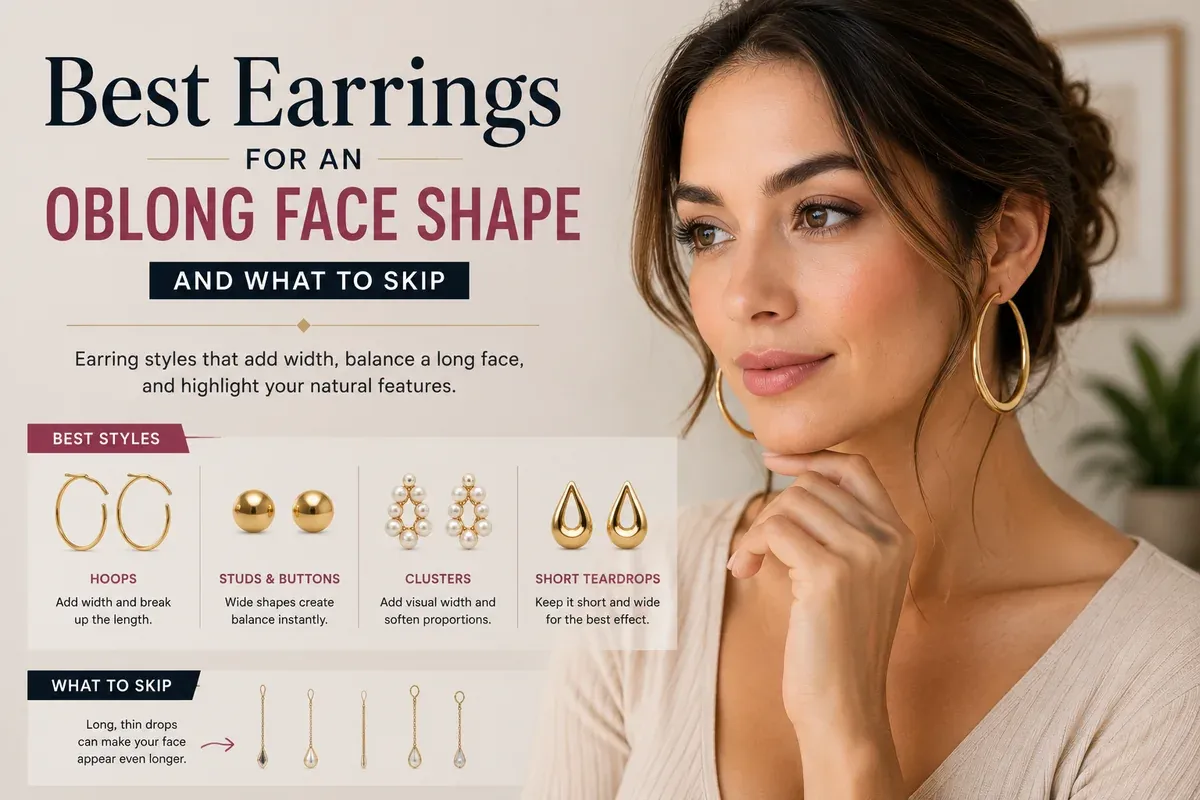
If your goal is to reduce vertical emphasis on a long face, choose earrings that are at least as wide as they are long, and place that width level with your cheek or jaw. Wide hoops, large studs, clusters and short teardrops do this. A long, narrow drop pulls the eye down the same line the face already runs along.
That is the whole principle. Everything below is about applying it to real earrings, and about the cases where the usual advice online contradicts itself.
What Do Earrings Change on an Oblong Face?
Earrings do not change the proportions of an oblong face. They change where someone’s eye goes when they look at it, and that is a real effect worth understanding rather than a polite fiction.
An oblong face reads as long because face length is clearly the largest measurement and the forehead, cheekbones and jaw sit close to one another in width. There is no strong widest point competing with the vertical line.
Earrings hang in exactly the zone where a widest point would help: beside the cheek and jaw, level with the lower third of the face. Anything you put there either interrupts the vertical run or extends it.
That is the mechanism. It is why the useful question about an earring is not what it is called but which direction it emphasises.
Earring Width Versus Length: The Ratio That Decides the Effect
Take any earring and ask two questions. How wide is it at its widest point? How far does it hang below the earlobe?
The ratio between those two numbers predicts the effect better than the style name does.
Wider than long creates horizontal emphasis. A flat disc, a wide hoop, a cluster, a button.
Roughly square is close to neutral and works with almost anything.
Longer than wide creates vertical emphasis, increasingly so as the ratio grows. A thin linear bar is the strongest version.
This matters because style names cut across the ratio. A hoop can be a slim 15mm circle or a wide 60mm one. A chandelier can be broad and tiered or narrow and cascading. Two earrings sold under the same name can point in opposite directions.
It also explains a contradiction you will meet quickly if you read around this topic. Some guides recommend chandeliers and long drops for a long face on the grounds that they add width at the bottom; others tell you to avoid all dangly earrings. Both are describing real earrings and neither is stating the rule. A tiered chandelier that grows wider as it descends genuinely does add width. A narrow cascade of the same length does not.
Which Earring Styles Add Width to an Oblong Face?
Five earring styles add width to an oblong face: hoops, large studs and buttons, clusters, short teardrops worn wide end down, and geometric shapes with a horizontal edge.
Hoops
Hoops are the most dependable earrings for an oblong face, because the geometry does the work. A circle is at its widest exactly halfway down, which puts the widest point beside the jaw without any thought about placement.
Medium hoops, roughly the width of your jaw, read as balanced. Larger hoops work too, as long as width grows with the drop rather than the hoop simply becoming a long oval. Thickness matters as well: a chunky or flattened hoop carries more visible mass than a fine wire of the same diameter, so it registers as width more strongly.
Large Studs and Buttons
Studs add interest with essentially no vertical component. Oversized studs, flat discs, round pearls and domed buttons all sit level with the lobe and read sideways.
They are the low-risk choice if you are unsure, and the practical choice if you wear glasses, because they do not compete with the frame.
Clusters
A cluster spreads several elements outward from the post rather than hanging them in a line. That produces width and visual interest at once, which is why clusters often suit a long face better than a single stone of the same size.
Cluster-drops, where a compact cluster sits at the end of a very short drop, keep most of the effect while adding a little movement.
Short Teardrops and Pear Shapes, Worn the Wide Way
A teardrop is worth thinking about carefully, because orientation flips its effect. A pear shape hung point-up, widening toward the bottom, adds width low on the face. The same shape hung point-down narrows as it descends and reads as a taper.
The detail is easy to check in a mirror and easy to miss on a product page.
Geometric and Angular Styles
Squares, wide rectangles, triangles worn base-down and flat geometric panels all work on the same logic: a defined horizontal edge gives the eye something to stop on.
The one to look at twice is a long narrow rectangle, which is geometric but firmly vertical.
Earring Styles for an Oblong Face Compared
| Earring style | Visual effect | Best if your goal is | Consideration |
|---|---|---|---|
| Wide or chunky hoop | Strong horizontal at jaw level | Adding perceived width | Weight, and catching on hair or scarves |
| Large stud or button | Horizontal, no drop at all | Everyday wear, wearing glasses | Can read as understated with big features |
| Cluster | Width plus visual interest | Occasions, adding volume | Scale needs to suit your features |
| Short teardrop, wide end down | Width low on the face | Softening a long lower face | Check the orientation before buying |
| Tiered chandelier | Width that grows downward | Statement wear | Overall length still adds vertical line |
| Long narrow drop | Vertical emphasis | A deliberately elongated look | Pair with width elsewhere if that is not the goal |
| Linear bar or threader | Strongest vertical emphasis | Minimalist styling by preference | Least likely to reduce perceived length |
Can You Wear Long Drop Earrings With an Oblong Face?
Yes. Long drop earrings are not off limits on an oblong face. Personal preference is a legitimate reason to wear something, and a style you enjoy usually looks better than a technically balanced one you feel unsure in.
If you want the length and also want to keep the proportions balanced, four adjustments help.
Choose a drop that widens as it falls. A tiered or graduated design ends on width rather than on a point.
Add width somewhere else at the same time. Hair with volume at the cheekbone, or a wider frame if you wear glasses, gives the eye a horizontal to balance against.
Break up the vertical line within the earring. A drop made of distinct segments reads as a series of shapes rather than one continuous line.
Watch where it ends. A drop finishing at the jaw sits inside the face’s own outline. One finishing well below the jaw extends the line past it, which is the strongest lengthening version.
How Your Hairstyle Changes the Way Earrings Read
The same earring reads very differently depending on what your hair is doing, and that is worth testing before you buy anything.
Hair tied back leaves the earring as the only shape beside your face. Its proportions show at full strength, which is when a wide hoop or cluster does the most work and when a narrow drop is most noticeably vertical.
Hair down and straight frames the earring in two vertical curtains. A narrow drop disappears into that line. A wide style has to be wide enough to read against it.
Hair down with volume or waves at the cheekbone is already supplying horizontal emphasis. Earrings can be smaller and still look balanced, and a longer drop becomes an easier choice.
The practical version: try each pair twice, once with your hair up and once with it down as you normally wear it, and look straight on rather than in profile. Proportion is a straight-on effect.
Our guide to hairstyles for women with an oblong face covers where layers and bangs place that width, which is useful context if you are choosing both at once.
How Glasses and Necklines Change the Effect of Earrings
Earrings work together with glasses, necklines and hair colour.
Glasses draw the strongest horizontal line on a face, at eye level. If you wear them, much of the balancing work is already done, and a smaller earring often looks better than a second statement piece. Glasses for women with an oblong face covers the frame shapes that do this.
Necklines set what happens below the earring. A wide or boat neckline continues the horizontal; a deep V draws a long vertical that a long drop will follow. Pairing a deep V with a linear earring produces the most elongated combination available.
Hair colour and earring metal matter for visibility rather than proportion. An earring that blends into your hair colour reads as smaller than it is.
Earring Weight, Lobe Size and Scale: What Proportion Rules Miss
Weight. Wide hoops and large clusters are heavier than they look. An earring that drags on the lobe by mid-afternoon will not get worn, whatever its proportions.
Ear position and lobe size. Earlobes vary in length and attachment. On a short lobe, a heavy stud can sit lower than the design intends; on a long lobe, a short drop hangs further than expected. This is a mirror question, not a chart question.
Scale relative to your features. Someone with a long but narrow face and fine features needs a different size from someone with a long face and strong features, even though both are oblong. Face-shape guidance describes proportion, not size.
Your own preference. If you have worn small studs for twenty years and like them, that is a complete reason.
How to Test Earring Proportions on Your Own Face
You do not need to take anyone’s word for the width-versus-length claim. Compare it directly.
- Pick three pairs you already own: something wide, something roughly square and something long and narrow.
- Tie your hair back so nothing else is in the frame.
- Photograph yourself straight on in each pair, in the same light and at the same distance.
- Look at the three photos side by side rather than one at a time. The difference is much easier to see in comparison than in sequence.
Most people find the effect is real but smaller than the internet suggests. That is useful to know too, and it takes the pressure off the decision.
If you are still unsure whether oblong is the right label for your proportions in the first place, the face shape detector scores all seven shapes from a photo or four measurements and shows the numbers behind the result.
Summary: Choosing Earrings for an Oblong Face
Ask how wide the earring is compared with how long it hangs. Wider than long adds horizontal emphasis at the level of your jaw, which is where a long face gains most from it. Longer than wide extends the line the face already has.
Then check it against your hair, your glasses and your neckline, because those are doing at least as much as the earring is. And if you love a style that breaks every one of these guidelines, wear it.
Frequently Asked Questions
Short answers to the questions that come up most often on this topic.
What earrings suit an oblong face shape?
Can you wear long dangly earrings with a long face?
Do hoops look good on a long face?
Should earring size match face size?
How do earrings and glasses work together on a long face?