Eyewear
Glasses for Women With an Oblong Face Shape
Frames that suit an oblong face on women: round, cat-eye and wide rectangular shapes, the frame measurements that matter, and what works less well.
By Ayla Willow ·
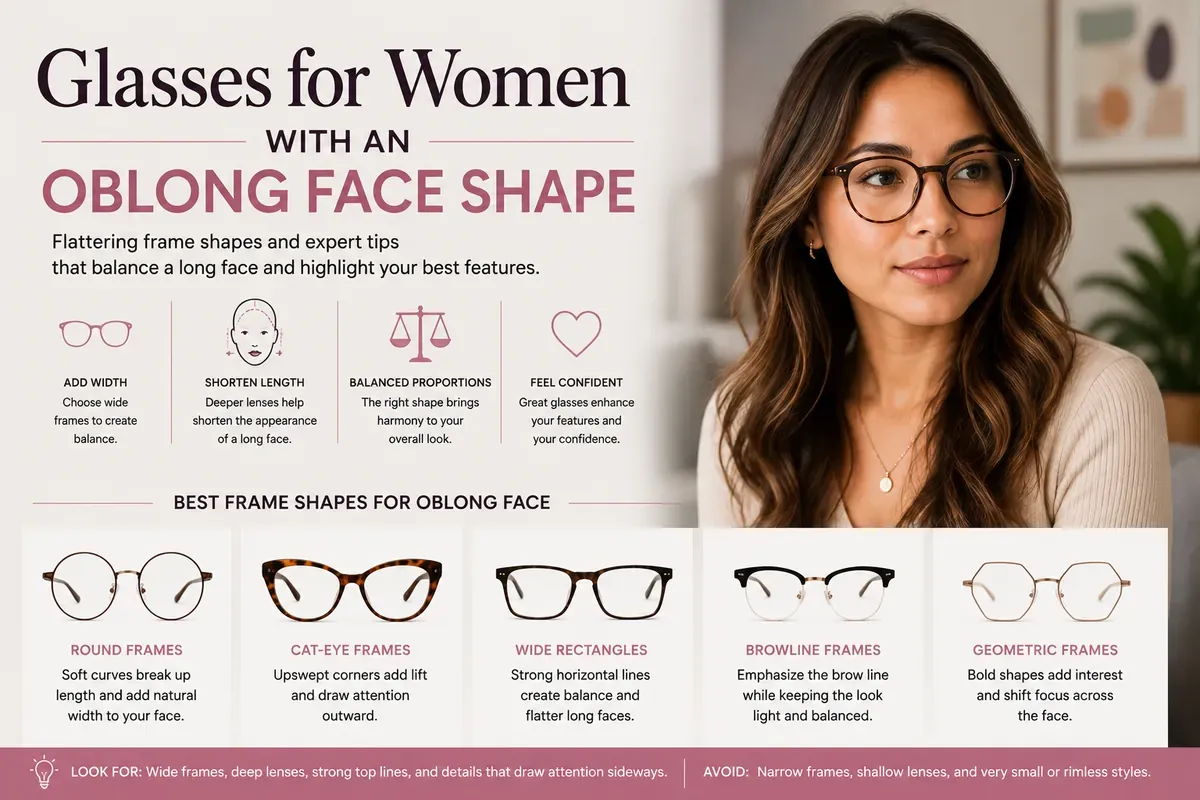
Frames sit across the middle of the face at the exact height where an oblong face gains most from added width. That makes them one of the most effective styling decisions available, and it explains why two pairs in the same prescription can change your proportions so differently.
The short answer: choose frames that are wide and deep. Slightly oversized round frames, deep cat-eyes, wide rectangles and browlines all balance a long face. Narrow frames, very shallow lenses and rimless styles add almost no horizontal line, so they leave the proportions as they were.
What Do Glasses Do for an Oblong Face?
Glasses change an oblong face in two ways: the frame draws a horizontal line at eye level, and the lens covers part of the mid-face.
An oblong face has more length than width, with the forehead, cheekbones and jaw measuring close to one another. There is no strong widest point to work with. The face shape detector on the homepage will show you where your own measurements land if you want to check before you shop.
A frame changes that face in two ways.
It draws a horizontal line at eye level. The wider and more visible that line, the more it interrupts the run from hairline to chin. This is why frame width and frame thickness both matter, and why a barely visible frame changes nothing.
It also fills vertical space. A deep lens covers more of the distance between brow and cheek, which shortens the mid-face visually. A very shallow lens leaves that distance open and can read as a thin stripe.
The most effective frames do both. The least effective do neither.
Which Frame Shapes Suit an Oblong Face on Women?
Five frame shapes suit an oblong face on women: larger round frames, deep cat-eyes, wide rectangles and squares, browlines, and geometric shapes that are widest at eye level.
Round Frames, on the Larger Side
Round frames work through their curve. The widest point of a circle sits level with the pupil, so a pair puts two areas of width across the middle of the face. The curve also contrasts with a long, comparatively straight face, which is part of why the shape reads well.
Size is the variable that decides whether it works. A slightly oversized round frame spans enough of the face to matter. A small circular lens can look adrift on a long face.
Cat-Eye Frames with Depth
A cat-eye lifts and widens at the outer corners, pulling the eye sideways and away from the centre of the face. That upswept line is genuinely useful here, since it adds width at exactly eye level.
The version that works best on a long face is a deeper, fuller cat-eye rather than a slim retro one. The shape is doing two jobs at once: providing the horizontal sweep and covering enough mid-face to shorten it. A very shallow cat-eye only manages the first.
Wide Rectangular and Square Frames
Wide rectangular frames are the most straightforward option for an oblong face. A rectangle with a clear horizontal top line and reasonable depth delivers both effects with no styling risk. Acetate construction in medium to thick reads stronger than fine metal, because the visible mass of the frame reinforces the line.
Square frames with deep lenses are the choice if you want more coverage. They suit larger features and stronger prescriptions, and they cover more of the mid-face than a shallow rectangle can.
Browline Frames
A browline concentrates its weight along the top rim, with a lighter lower half. All of the visual mass sits along one horizontal line at brow height, which is the single most useful place to put it on a long face. It is a good option if you want the balancing effect without the frame reading as heavy overall.
Bold Geometric Shapes
Hexagonal, octagonal and other angular frames can work, with one condition: the widest point needs to sit at eye level rather than at the top or bottom of the lens. A hexagon that is widest across the middle behaves like a round frame. One that tapers sharply toward a narrow bottom edge points downward and follows the length of the face.
Frame Shapes for an Oblong Face Compared
| Frame shape | Where the width sits | Lens depth | Reads as | Best for |
|---|---|---|---|---|
| Oversized round | Level with the eye, curved | Medium to deep | Soft, distinctive | Contrast with a long straight face |
| Deep cat-eye | Outer corners, upswept | Medium to deep | Defined, classic | Adding width and lift together |
| Wide rectangle | Straight top line | Medium | Neutral, everyday | Work, any prescription |
| Large square | Straight, plus coverage | Deep | Substantial | Larger features, more coverage |
| Browline | Concentrated at the brow | Medium | Structured | Balance without visual bulk |
| Slim rimless | Almost none | Any | Understated | Comfort and lightness, not balance |
Which Frame Measurements Matter for an Oblong Face?
Frames print three numbers inside the temple arm, usually in the form 52-17-140. Knowing what they mean makes shopping far more reliable than judging by eye.
- Lens width, the first number in millimetres, is the width of one lens. Larger figures cover more of the face horizontally.
- Bridge width, the second number, is the gap between lenses. It governs fit rather than proportion, but a badly sized bridge makes a frame ride up or slide down.
- Temple length, the third number, is the arm length and affects only how the frame sits behind the ear.
- Lens height is rarely printed. Measure it with a ruler on a frame you own. Roughly 38mm or more stops a frame reading as a band across a long face.
- Total frame width, hinge to hinge, is the number that decides proportion. Compare it with your own face width at the temples, measured with a soft tape at eye level. Matching it, or exceeding it very slightly, keeps the horizontal line running the full width of your face.
If a pair you already own suits you, note its numbers. They give you a shopping target that survives the difference between one brand’s sizing and another’s.
How Frame Colour, Material and Temple Detail Change the Effect
Frame colour changes how strong the horizontal line reads. A frame that contrasts with your hair and skin stands out more, which strengthens the effect. A frame close in tone to your skin blends in and does less.
Thickness works the same way. A medium to thick acetate keeps the line visible; fine metal reduces it.
Temples are a smaller lever but they point in the same direction. Detail, colour or extra width on the arms draws attention to the sides of the head rather than the centre. It is a subtle effect, but it costs nothing to choose the version that has it.
Which Glasses Lengthen an Oblong Face?
Narrow frames, very shallow lenses, rimless styles, small round frames and shapes with a strong downward taper do the least for an oblong face. None of these is an error; each one simply does less of the work, or reinforces the length that is already there.
Narrow frames. A frame noticeably narrower than your face leaves cheek visible on both sides and concentrates everything in the middle, which lengthens the look. This is the most common misfit on a long face.
Very shallow lenses. Slim low-profile frames are comfortable and popular, but on a long face the frame can read as a stripe rather than a shape. Adding depth is often the fix when a frame you like feels wrong for reasons you cannot place.
Rimless and thin wire frames. They effectively disappear. That is sometimes the intention, but if you want the frame to work with your proportions it is the least effective option.
Small round or small oval frames. Round works at size. Small round frames sit in the centre of a long face without spanning enough of it.
Frames with a strong downward taper. Shapes that narrow sharply toward the bottom edge point in the direction the face already runs.
Frames sitting high on the nose. A gap between eyebrow and top rim breaks the horizontal band that makes a frame effective. Sitting a little lower, with the rim close to the brow line, works better.
How to Shop for Glasses for an Oblong Face
- Note the numbers on a pair you already like. Read the printed figures and measure the lens height yourself.
- Measure your face width at the temples. A soft tape across the widest point at eye level gives you the figure to match.
- Filter by frame width first. Most online retailers let you filter by width or size band. Doing that before you browse shapes removes most of what will not fit.
- Check lens depth before shape. A frame with the right depth in a shape you were unsure about usually beats a shallow frame in the shape you wanted.
- Look straight on and in profile. Straight on shows you the width. In profile shows whether the frame sits flat against your face or stands away from it.
- Check where the top rim lands. It should follow your brow closely rather than cutting across the eyebrow or sitting below it.
- Try the pair on with your hair as you normally wear it. A fringe changes how a frame reads considerably, and so does hair pulled back.
Why Frame Fit Comes Before Frame Shape
The right shape in the wrong fit will not look right. The frame should not slide when you look down, the temples should follow the side of your head without pressure, and the lens should sit clear of your lashes.
Prescription strength is worth raising with the optician before committing to a large frame. Wide frames with a strong minus prescription produce thicker lens edges. High-index lenses reduce that, and a slightly smaller frame in the same shape is often the practical compromise.
How Glasses Work With Hair, Brows and Makeup
Frames are one of several things acting on the same face, and they work best when they agree with each other.
A fringe shortens the forehead directly above where your frames sit, which reinforces the same effect. Hairstyles for women with an oblong face covers the cuts that pair well.
Brow shape sits immediately above the frame. A flatter, more horizontal brow with a soft rather than a high arch keeps the eye moving across the face, which is the same direction the frame is working in.
Blush and bronzer placement follows the same logic. Makeup for women with an oblong face covers where each product goes.
For non-prescription frames, sunglasses for women with an oblong face applies the same ideas at a larger scale.
Are These Frame Rules Mandatory for an Oblong Face?
No. These frame guidelines describe proportion, not corrections. An oblong face is a normal, common face shape and nothing here suggests otherwise. Glasses also do a job beyond appearance: prescription, comfort and weight matter as much as shape does.
If a frame you love falls outside all of this, wear it. How you feel in a pair of glasses shows more clearly than proportion does. Use this to understand why one pair sits better on you than another, then decide for yourself.
Frequently Asked Questions
Short answers to the questions that come up most often on this topic.
What glasses suit a woman with a long face?
Do cat-eye glasses suit an oblong face?
Are round glasses good for a long face?
What frame width should I look for?
Do decorative temples make a difference?