How to
How to Measure Your Face Shape at Home: 4 Measurements
A repeatable method for measuring forehead, cheekbone, jaw and face length at home, the mistakes that shift the result, and how to read the four numbers.
By Ayla Willow ·
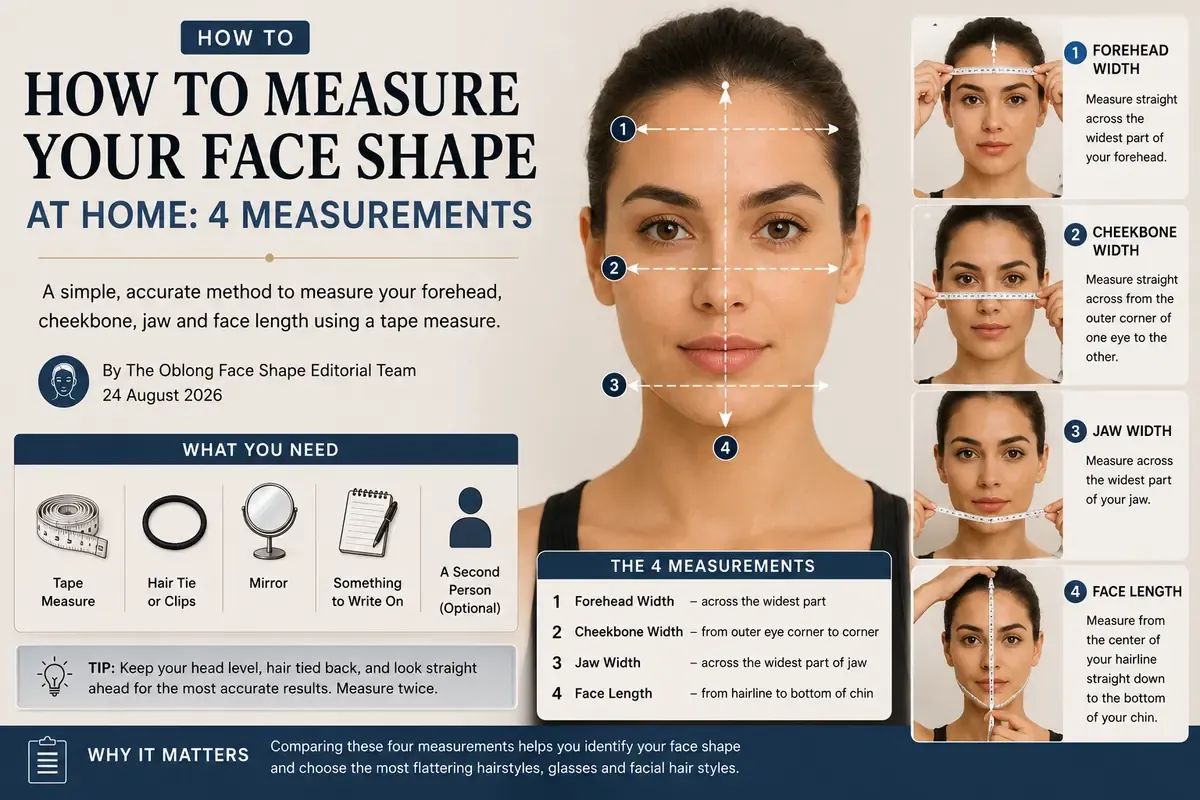
You need four numbers: forehead width, cheekbone width, jaw width and face length. Take each one straight across or straight down rather than following the curve of your face, take them all twice, and compare them against one another rather than against a fixed target.
That comparison is what identifies your face shape. A tape measure and ten minutes is all the equipment involved.
What Do You Need to Measure Your Face Shape?
You need five things to measure your face shape, and none of them is specialised.
- A flexible tape measure, the fabric or tailor’s kind. A rigid ruler cannot sit flat against a curved face, and a piece of string measured afterwards against a ruler works if that is what you have.
- A hair tie or clips. Hair across the temples or jaw is the most common reason a measurement comes out wrong.
- A mirror, positioned so you can stand square to it.
- Somewhere to write the numbers down. Four measurements taken twice is eight numbers, and remembering them is harder than it sounds.
- A second person, optional but useful. Face length in particular is easier when someone else holds the tape.
Work in millimetres or in eighths of an inch. The differences that matter here are small, and rounding to the nearest centimetre loses them.
How to Take the Four Face Measurements, Step by Step
1. Set up Before You Measure Anything
Tie all of your hair back, including anything covering your temples or falling along your jaw. Stand square to the mirror with your head level, not tipped up or down, and let your expression relax.
Light matters more than people expect. Even light from the front is what you want. Light from one side casts shadows that read as bone structure and will influence where you think your cheekbones are.
2. Forehead Width
Measure straight across the widest part of your forehead. For most people that sits roughly halfway between the eyebrows and the hairline.
Keep the tape flat, as though you were measuring the width of a photograph of your face. It should not curve around the front of your skull.
The mistake to avoid: measuring along your hairline. Hairlines recede, sit low, or come to a peak, and none of that changes the width of the bone underneath. Two people with identical foreheads and different hairlines should get the same number here, and they will only if you ignore the hairline and find the widest point.
3. Cheekbone Width
Measure straight across from the outer corner of one eye to the outer corner of the other, passing over the top of the cheekbones.
If you cannot find the cheekbones by feel, smile gently. That lifts them and makes the high point easier to locate, then relax before you take the reading.
The mistake to avoid: letting the tape dip into the hollow under the cheekbone or follow the contour of the cheek. Both add length that is not width. Keep it flat and straight.
4. Jaw Width
Find the widest part of your jaw. It is usually just below and slightly forward of your ears, where the jawbone turns from the vertical section up toward the ear into the horizontal section running to the chin.
Measure straight across from that point on one side to the same point on the other.
The mistake to avoid: measuring from earlobe to chin and doubling it. That is a common shortcut, and it measures a diagonal rather than a width. It produces a larger number than the true jaw width and is not comparable with the other two measurements, which are straight across. If you want your jaw width to sit alongside your forehead and cheekbone numbers, measure it the same way they were measured.
5. Face Length
Measure from the centre of your hairline straight down the middle of your face to the base of your chin.
Keep the tape vertical and against the skin, but do not press it into the hollows at the eyes or around the nose. It should follow a straight line down, not the profile of your face.
The mistake to avoid: two of them, actually. First, tipping your head while you look down at the tape, which shortens the reading. Use the mirror or a second person. Second, guessing at the hairline. If yours is uneven or receding, use the point where hair growth begins at the centre of the forehead, and use the same point both times.
6. Take Everything Twice
Measure all four again, ideally after standing up and sitting back down so you are not simply repeating the same hand position.
If two readings of the same measurement differ by more than a few millimetres, take a third and average them. If they differ a lot, something in your method is changing between attempts, and the usual culprits are head tilt and tape tension.
This step is the one most guides skip and the one that does the most for reliability. A single set of numbers tells you a result. Two sets tell you whether the result is stable.
7. Compare the Numbers
Measuring is only half the job. The four figures identify a shape when you compare them against one another: face length against average width, then the three widths against each other, then the shape of the jaw corners.
The next section works through that comparison in full.
How to Work Out Your Face Shape From the Four Numbers
Two comparisons turn the four measurements into a face shape.
First, length against width. Add your three widths and divide by three to get an average width. Then divide face length by that average.
A result close to 1.0 means your face is about as wide as it is long, which points toward round or square. A clearly higher result means your face is longer than it is wide, which points toward oblong, rectangle, oval or heart.
Second, the widths against each other. Look at which of the three is largest and by how much.
If the cheekbones lead clearly, that points to round, oval or diamond. If the forehead leads clearly, that points to heart. If all three sit close together, within roughly a centimetre of one another, that points to oblong, square or rectangle depending on your length ratio and jaw.
Then check the jaw shape, which is not a measurement. Trace from below your ear to your chin with a finger and notice whether the line turns a visible corner or follows a continuous curve. Angular corners point to square or rectangle. A curve points to oblong or round.
How the Measurements Differ Across the Seven Face Shapes
| Shape | Length vs average width | Widest measurement | Jaw shape |
|---|---|---|---|
| Oblong | Clearly longer | No clear leader, three widths close | Curved |
| Rectangle | Clearly longer | No clear leader, three widths close | Angular |
| Oval | Moderately longer | Cheekbones, slightly | Curved, gentle taper |
| Square | Close to equal | No clear leader, three widths close | Angular |
| Round | Close to equal | Cheekbones | Curved |
| Heart | Longer | Forehead | Narrow, tapering to a point |
| Diamond | Longer | Cheekbones, clearly | Narrow |
This table shows the patterns each shape typically produces. It is deliberately written in relative terms, because that is what the evidence supports.
Is There an Exact Ratio That Defines Each Face Shape?
No single ratio is agreed. You will find sites that give an exact figure: a face is oblong if the length divided by the width exceeds some specific number.
Treat those with caution. Different charts use different cut-offs and they disagree with each other, because face-shape classification grew out of styling practice rather than from anthropometric standards. There is no authority that has fixed the boundaries, and no clinical reason to.
What the numbers reliably tell you is the direction and the degree: whether your face is long or compact, and by how much. That is enough to choose a haircut or a frame, which is what the categories exist for.
What they cannot do is place a borderline face definitively into one box. If your ratio sits between two shapes, that reflects a real property of your face rather than an error in your measuring.
Common Reasons a Face Measurement Comes Out Wrong
Hair in the way. The single most frequent cause. Tie everything back, including the pieces you normally leave loose.
Following the curve instead of measuring across. This inflates all three widths, and because it inflates them unevenly it changes which one looks widest.
Measuring the jaw diagonally. Covered above, and worth repeating because the earlobe-to-chin method appears in a lot of guides.
Head tilt during the length measurement. Looking down at the tape shortens the reading by a surprising amount.
Measuring after sleep or a long flight. Facial fullness varies through the day and with fluid retention. It affects apparent cheek width more than bone width, but it is a reason to take your second reading at a different time.
Pulling the tape tight. Firm contact is right; compressing the skin is not. Use the same tension every time.
How to Measure Someone Else’s Face Shape
If you have a second person available, swapping roles is worth the two minutes.
Someone else measuring you removes the two largest sources of error at once: you are not tipping your head to see the tape, and you are not adjusting the tape by feel while trying to hold a position. Face length in particular becomes much more reliable.
It also gives you a second opinion on the judgement calls. Where the widest part of a forehead sits, and where a jaw stops being vertical and starts running toward the chin, are both easier for an observer to see than for you to feel.
If you are measuring someone else, tell them to keep looking straight ahead rather than following your hands, and take each reading with the tape resting on the skin rather than pressed into it. Read the number off while the tape is still in place, not after you have lifted it.
Compare their numbers with yours if you both measured. Differences of a few millimetres are expected. Larger gaps usually point to one of you following the curve of the face rather than measuring straight across.
How to Check Your Face Shape Result With the Detector
Manual measurement and an automated reading are useful together, because they fail differently. A tape measure depends on your placement; an automated reading depends on the photo.
Once you have your four numbers, you can enter them into the face shape detector on the homepage. It scores all seven shapes rather than returning a single label, and it shows the measurements it used, so you can see how close the second-place shape was. It also works from a photo or your camera if you would rather compare that against your manual result.
Everything runs in your browser, so nothing is uploaded.
If the two methods disagree, the disagreement itself is informative: it usually means your proportions sit between two shapes, which is the most common outcome for a face that is hard to classify by eye.
What If Your Measurements Land Between Two Face Shapes?
Landing between two face shapes happens to a lot of people and does not mean you measured badly.
Take the two closest shapes and read the styling guidance for both. Where they agree, follow it. Where they disagree, try each and judge in the mirror, which is the final authority for a system that exists to guide appearance decisions.
Oblong vs square, round and heart works through the specific features that separate the shapes most often confused with a long face, one comparison at a time.
Summary: How to Measure Your Face Shape
Tie your hair back. Measure forehead, cheekbones and jaw straight across, and face length straight down. Do it twice. Divide length by average width to see how long your face is, compare the three widths to find your widest point, and check whether your jaw corners are angular or curved.
Those three findings identify your shape closely enough to make styling decisions from, which is the only thing the categories were built to do.
Frequently Asked Questions
Short answers to the questions that come up most often on this topic.
What do I need to measure my face shape?
Where exactly do I measure the forehead?
Should I measure straight across or follow the curve of my face?
How accurate does this need to be?
Is there an exact ratio that proves a face is oblong?