Grooming
Beard Styles for Men With an Oblong Face Shape
Beard styles that suit an oblong face: stubble, short boxed and squared full beards, where to set the cheek line and neckline, and what to approach with care.
By Ayla Willow ·
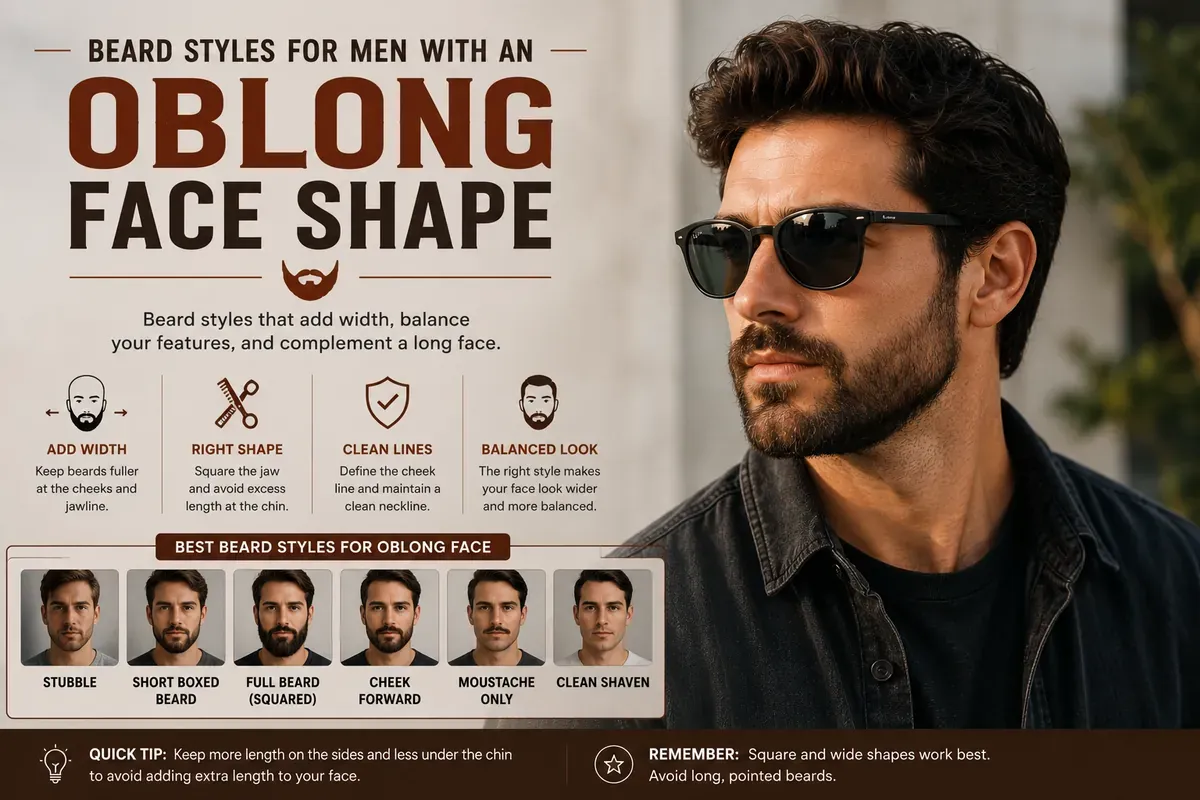
A beard is the only styling choice that changes the outline of the lower half of your face. On an oblong face, where the jaw measures close to the cheekbones and the whole face reads as long, that makes facial hair one of the more effective adjustments available, provided the length goes in the right direction.
The short answer: build width, not length. Keep the beard fuller at the cheeks and along the jaw, and keep it short under the chin. Short boxed beards, even stubble and squared-off full beards all work. Goatees, long chin hair, ducktails and pointed styles extend the face downward.
What Does a Beard Do for an Oblong Face?
A beard changes the outline of the lower third of an oblong face: hair left at the sides adds width, and hair left under the chin adds length.
An oblong face has more length than width and very little difference between the forehead, cheekbone and jaw measurements. The face shape detector on the homepage will show you where your own measurements land if you want to check.
A beard sits over the bottom third of that face, which means it can change the perceived shape more than anything except a haircut. It does so in one of two directions.
Hair left long at the sides and along the jaw extends the outline outward. The face reads as wider at the bottom, which brings the width closer to the length and balances the proportions.
Hair left long under the chin extends the outline downward. The face reads as longer. Same beard, same amount of hair, opposite result, decided entirely by where the length was left.
That single distinction is worth more than any list of style names.
Which Beard Styles Suit an Oblong Face?
Six options suit an oblong face: stubble, a short boxed beard, a full beard trimmed square, cheek-forward styles, a moustache on its own and a clean shave.
Stubble, Light or Heavy
Stubble is the lowest-effort beard style for an oblong face, and it is effective. Stubble kept even across the cheeks, jaw and chin creates a band of shadow across the lower face, which reads as width. It requires no shaping beyond a neckline, holds its look for days, and works with any haircut.
Heavy stubble, roughly three to five millimetres, has more visual weight than light stubble and does slightly more. Both are good starting points if you are unsure how much beard suits you.
Short Boxed Beard
A short boxed beard is the most reliable full-coverage style for an oblong face. A boxed beard is trimmed to a consistent short length, with the cheek line defined and the beard squared off along the jaw rather than rounded under the chin.
That squared bottom edge is the point. It gives the lower face a horizontal line at the jaw, which is exactly where a long face benefits from one. Keeping the length even, rather than letting the chin grow longer than the sides, is what separates a boxed beard from a beard that has simply grown out.
Full Beard, Trimmed Square
A full beard works on an oblong face when it is trimmed with the shape in mind: longer through the cheeks and along the jawline, shorter directly under the chin, and cut flat across the bottom rather than tapered to a point.
Trimming a full beard this way takes it from a shape that lengthens to one that widens, without losing the fullness.
Cheek-Forward Styles
Styles that concentrate hair on the cheeks, including mutton chops and their tidier modern variants, put the width at the top of the beard where the face is widest. They are a strong statement rather than a neutral choice, but they work with these proportions rather than against them.
A Moustache on Its Own
A moustache draws a horizontal line across the middle of the lower face. A wider style that extends past the corners of the mouth, such as a chevron or a walrus, has more of that horizontal effect than a narrow, closely trimmed one. It is a good option if a full beard is not practical for you.
Clean Shaven
A clean shave is a perfectly good option on an oblong face. It is neutral rather than counterproductive, and if you would rather not maintain a beard, a haircut with a fringe and a well-chosen frame do plenty on their own.
Beard Styles for an Oblong Face Compared
| Style | Where the width sits | Maintenance | Reads as | Best for |
|---|---|---|---|---|
| Light stubble | Even across the lower face | Every 2 to 3 days | Casual, low key | Trying facial hair, patchy growth |
| Heavy stubble | Even, with more weight | Every 3 to 4 days | Relaxed, defined | Most faces, little effort |
| Short boxed beard | Cheeks and jaw, squared | Weekly trim | Tidy, deliberate | Everyday wear, offices |
| Full beard, trimmed square | Cheeks and jaw | Weekly shaping | Substantial | Fuller growth, more presence |
| Cheek-forward styles | High on the cheeks | Regular shaping | Distinctive | A strong statement |
| Moustache only | Across the mouth | Low to moderate | Characterful | When a beard is impractical |
Where to Set the Cheek Line and Neckline on an Oblong Face
Most of a beard’s shape comes from three edges. Getting them right matters more than the style name.
- Set the cheek line high and follow your growth. Run an imaginary line from the corner of your sideburn to the corner of your mouth. Your natural growth line is usually near this. Tidy above it rather than carving a new line well below it, since every millimetre you take off the cheek is width you are removing.
- Keep the cheek line soft rather than razor sharp. A hard, deliberately shaved curve draws attention to itself. A natural edge lightly cleaned up sits better and gives the beard more apparent width.
- Set the neckline about two finger widths above the Adam’s apple. Find the point where your jaw meets your neck, come down roughly two fingers, and shave everything below in a gentle curve. A neckline set too high, along the jawbone itself, cuts the beard off at the jaw and removes the very shape you built.
- Trim the bottom flat, not round. With the beard combed down, cut straight across underneath the chin rather than following the curve of your jaw into a point. A flat bottom edge is what makes a beard read square.
- Take the chin shorter than the sides. Set your trimmer one guard length shorter for the area directly under the chin than for the cheeks and jaw. This is the single adjustment that does most of the work.
- Check it straight on in a mirror, not in profile. Width is a straight-on effect. A beard that looks well shaped in profile can still be too narrow from the front.
Which Beard Styles Lengthen an Oblong Face?
Goatees, Van Dykes, long pointed beards, chinstraps, soul patches and a very low cheek line all lengthen an oblong face. None of these styles is a mistake, and plenty of people wear them by choice; each one simply runs in the same direction the face already runs.
Goatees and chin-only styles. They put hair in a narrow strip at the centre of the chin and leave the sides bare, drawing a vertical line down the middle of a long face. Widening a goatee so it connects to the jaw improves it considerably.
Van Dyke styles. A moustache with a disconnected pointed chin beard concentrates everything on the vertical centre line.
Long or pointed beards. A ducktail, a tapered full beard or anything that comes to a point below the chin adds directly to the length of the face.
Chinstraps. A narrow line following the jaw with nothing above it emphasises the outline of a long jaw without adding any width to it.
Soul patches on their own. They mark the centre line at the chin and add nothing horizontal.
A very low cheek line. Shaving the cheeks down close to the jaw narrows the beard at its widest point, which cancels out most of what a beard is doing for you.
How to Trim a Beard So It Keeps a Square Shape
- Trim dry and combed. Wet hair sits shorter and straighter than it will when dry, which leads to taking off more than you meant to.
- Comb it downward and outward before you start. Combing outward at the cheeks shows you how much width you actually have.
- Do the length first, then the edges. Set the overall length with a guard, going against the growth direction for an even finish, then clean up the neckline and cheek line last.
- Use a shorter guard under the chin. One or two steps shorter than the sides is usually enough.
- Work in small passes. You can always take more off; you cannot put it back.
- Trim weekly rather than monthly. A beard drifts toward round and pointed as it grows, so short regular trims keep the square shape without ever taking much off.
What to Do If Your Beard Growth Is Patchy
Beard growth varies a lot between individuals, and patchiness at the cheeks is common. It is worth knowing that this affects what is practical rather than what looks good.
If your cheeks fill in slowly, stubble is usually a better route than a full beard, because at short lengths gaps are far less visible. Letting the beard grow for four to six weeks before judging it also helps, since sparse areas often fill in as the surrounding hair lengthens and lies over them.
If the cheeks stay sparse, a shape built lower on the jaw with a defined moustache is a practical alternative. What you should not do is shave the cheek line lower to hide the gap, since that removes the width the beard was there to provide.
How a Beard Works With a Haircut and Glasses
A beard is one of three things acting on the same face.
Above it, a haircut with a fringe shortens the forehead, so the top and bottom of the face are both being brought inward. See hairstyles for men with an oblong face for the cuts that pair well.
Between them, frames draw the strongest horizontal line of all. Glasses for men with an oblong face and sunglasses for men with an oblong face cover the shapes that work.
Running all three at full strength can crowd the face. A heavy fringe, a full beard and thick frames together is a lot at once. Letting two lead and keeping the third light usually reads better.
Are These Beard Rules Mandatory for an Oblong Face?
No. These beard guidelines describe proportion, not corrections. An oblong face is an ordinary face shape and nothing here suggests otherwise. A beard is also a personal choice with practical constraints: workplace rules, how your hair grows, how much time you want to spend and whether you enjoy having one all matter as much as shape.
If a style you like sits outside all of this, wear it. Use the guidance to understand why one shape sits differently on you than another, then decide for yourself.
Frequently Asked Questions
Short answers to the questions that come up most often on this topic.
What beard suits a man with a long face?
Should men with long faces avoid goatees?
Does a beard make your face look longer or wider?
Is stubble a good option for an oblong face?
How high should the cheek line be on an oblong face?