Hairstyles
Oblong Face Shape Hairstyles for Men
Haircuts that suit an oblong face on men: textured crops, French crops, Caesar cuts and deep side parts, plus the styles that lengthen a long face.
By Ayla Willow ·
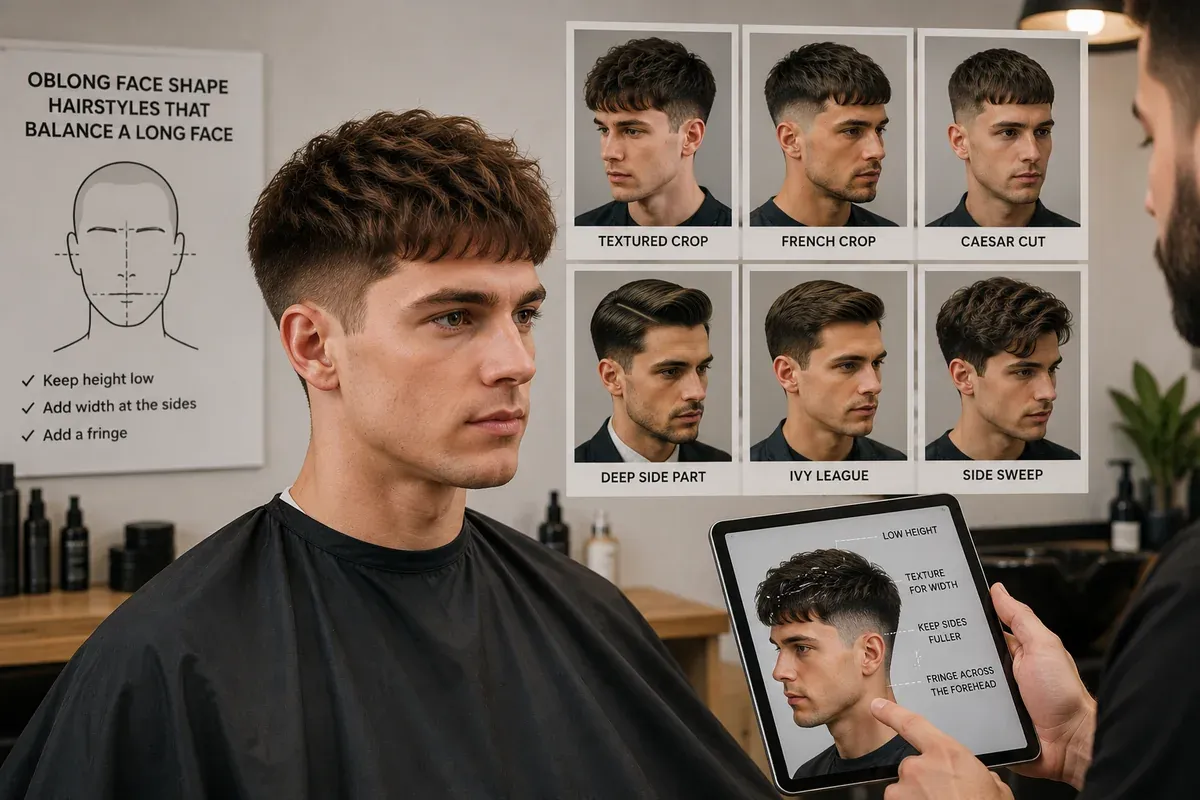
An oblong face has more room between the hairline and the chin than most other shapes, and less variation between the forehead, cheekbones and jaw. That combination is what makes a haircut so effective here: hair is the only thing on this list you can change in twenty minutes, and it sits directly on top of the measurement that defines the shape.
The short answer: keep height off the top, keep weight at the sides, and put something across the forehead. A textured crop with a low fade, a French crop, a Caesar cut or a deep side part all do those three things. Tall quiffs, high skin fades and slicked-back styles do the opposite.
What Does an Oblong Face Mean for a Man’s Haircut?
An oblong face reads as long because face length divides into average face width at a higher figure than other shapes, and because the forehead, cheekbones and jaw measure close to one another. There is no dramatic taper to work with and no obvious widest point. You can check where your own numbers land with the face shape detector on the homepage, which scores all seven shapes from a photo or four measurements.
Two consequences follow for hair.
The first is that the forehead is usually the longest single section of the face. Anything that exposes more of it, such as sweeping hair straight back, adds visible length. Anything that covers part of it, such as a fringe, takes length away.
The second is that the silhouette of your hair is read as part of your face. If the outline of your head is tall and narrow, that shape carries down into how the face is perceived. Building the outline wider than it is tall does more than any single cut name.
The Two Haircut Rules for an Oblong Face
Almost every haircut recommendation for an oblong face comes from two rules: keep height under control, and keep weight at the sides.
Keep vertical height under control. Two to three inches of length on top is enough for texture and movement. Beyond that, the hair starts to extend the vertical line rather than break it.
Keep horizontal weight at the sides. The area around the temples and above the ears is where width helps most, because it sits at eye level, roughly halfway down the face. Removing hair there narrows the middle of the head and stretches the face.
If a cut satisfies both, it will usually suit you regardless of what it is called.
Which Haircuts Suit an Oblong Face on Men?
Seven cuts suit an oblong face on men: a textured crop with a low fade, a French crop, a Caesar cut, a deep side part, a low Ivy League, medium length with side volume, and a buzz cut with a slightly longer front.
Textured Crop with a Low Fade
A textured crop with a low fade is the most adaptable haircut for an oblong face and the one worth trying first. The top is cut to roughly two inches, point cut or thinned so it separates rather than sitting as a solid block, then pushed forward into a short fringe. The sides taper low, starting around the ear rather than at the temple.
It works because it delivers everything an oblong face needs at once: a shortened forehead, texture that reads as width rather than height, and side weight left in place at eye level. It also suits straight, wavy and thick hair without much adjustment.
French Crop
A French crop is a close relative of the textured crop, with a blunter, heavier fringe cut in a straight line across the forehead. Where a textured crop leaves a soft, broken edge, the French crop makes a defined horizontal line. That line is the point: a hard horizontal cuts a long forehead in half and gives the eye something to stop on.
It suits straight to slightly wavy hair best. Very curly hair rarely holds the blunt edge, though a curly crop with a shorter front achieves a similar effect.
Caesar Cut
A Caesar cut is short all over, roughly one to two inches, with the top brushed forward into a short horizontal fringe. It is the lowest-maintenance cut on this list and one of the most effective for a long face, because the fringe sits high and flat and the overall silhouette stays close to the head without going tight at the sides.
Deep Side Part
A deep side part is a heavier alternative if you prefer classic styling. The part is set low, near the temple, and the hair is swept across the top rather than back. That diagonal sweep travels across the forehead instead of up from it, which shortens the visible forehead and creates asymmetry that breaks a long, even outline.
Keep the volume at the part low. A side part that is lifted into a wave at the front reintroduces the height you were trying to avoid.
Ivy League, Kept Low
An Ivy League is a slightly longer variation on a crew cut, with enough length at the front to be brushed across or forward. It is a good option for offices where a fringe feels too casual. The important detail is the front: styled forward or across it suits an oblong face, styled up it does not.
Medium Length with Side Volume
If you prefer more hair, medium length works provided it is layered so that the widest part of the silhouette sits at or above the ear. Hair that falls straight down past the jaw with no layers adds vertical line. Hair with movement through the sides adds width.
Buzz Cut and Short Crops
A buzz can look sharp on an oblong face, but a uniform buzz with no fringe and no side weight is the least forgiving version. Leaving a slightly longer front, or a number two on top graded into a number one at the sides rather than a skin fade, keeps a little more balance without changing the look much.
Men’s Haircuts for an Oblong Face Compared
| Cut | Length on top | Fringe | Side length | Best for |
|---|---|---|---|---|
| Textured crop, low fade | 2 to 3 in | Short, broken | Tapered from the ear | Most hair types, everyday wear |
| French crop | 1.5 to 2.5 in | Blunt, straight | Short but not faded high | Straight or slightly wavy hair |
| Caesar cut | 1 to 2 in | Short, horizontal | Even, close | Low maintenance, thinning hairline |
| Deep side part | 2 to 3 in | Swept across | Tapered, kept full | Formal settings, straight hair |
| Ivy League | 1.5 to 2.5 in | Brushed forward or across | Tapered | Offices, classic styling |
| Medium layered | 4 in and up | Optional | Layered, full at the ear | Wavy or thick hair, more length |
Why a Fringe Shortens an Oblong Face
If you only change one thing, change the front. A fringe shortens the forehead directly, and the forehead is usually where an oblong face gains most of its length.
The style of fringe matters less than its presence. A blunt fringe makes a hard horizontal line and has the strongest effect. A textured fringe with separation is softer and works better with a receding hairline, because a broken edge sits more naturally than a straight one. A side-swept fringe creates a diagonal, which shortens the forehead while looking less deliberate.
A fringe also gives you a lever you can adjust over time. Growing it slightly longer or shorter changes the proportions of your face more than any other half-inch of hair on your head.
Which Haircuts Lengthen an Oblong Face?
High and skin fades, pompadours and quiffs, slicked-back styles, long flat centre-parted hair and very tight sides with a tall top all lengthen an oblong face. None of these is a mistake, and plenty of people wear them well; each one simply pushes in the same direction the face already goes, so you are working against your proportions rather than with them.
High and skin fades. Fading the sides above the temple strips width from exactly the height where it helps. The result is a narrow band of hair sitting on top of a long face. A low or mid fade gives you the same clean finish without the cost.
Pompadours, quiffs and anything with height. Adding two or three inches of lift at the front extends the face upward. If you like the shape, ask for a low-volume version brushed forward and slightly up rather than straight up.
Slicked back. Pulling everything back exposes the full forehead and flattens the sides. It combines both of the things an oblong face is best avoiding.
Long hair worn flat and centre-parted. A centre part draws a vertical line straight down the middle of a face that is already long, and unlayered length adds more. A side part with layers solves both without cutting the length off.
Very tight sides with a lot of top. The disconnected look, where long top meets very short sides with no blend, produces a tall narrow silhouette. Blending the transition softens it considerably.
How to Ask a Barber for a Cut That Suits an Oblong Face
Barbers work from clipper numbers and lengths rather than style names, and the same style name can mean very different things in different shops. Describing the outcome you want gets better results than naming a cut.
- Lead with the shape, not the name. Say you want to keep width at the sides and avoid height on top. That single sentence tells a barber more than a photograph does.
- Give a number for the sides. A grade two or three tapered up from the ear is a useful starting point. Ask them not to take the taper above the temple.
- Give a length for the top. Two inches is a reliable request. Say you want it long enough to sit forward.
- Ask for texture, not thinning. Point cutting removes bulk while keeping the ends separated. Thinning shears used heavily can leave the hair sitting flat, which is the opposite of what you want.
- Ask for the front to be cut so it falls forward. Mention that you style it forward rather than back, so the front is cut to a length that works in that direction.
- Check it dry and styled before you leave. Hair cut wet sits differently once dry. Ask them to dry and style it so you can see the finished silhouette.
Bring a photo if you have one, but treat it as a reference for length and texture rather than a target. The cut has to work with your hairline and hair type.
How Hair Type Changes the Best Cut for an Oblong Face
Straight hair holds a blunt fringe well and takes a French crop or Caesar cleanly. It needs texture cut in, or it can sit flat and follow the shape of the skull.
Wavy hair is well suited to a textured crop, because the natural movement provides the width without styling effort. Keep the length short enough that the waves sit out rather than dropping down.
Curly hair already grows outward, which is an advantage here. A curly crop with a shorter front and length left through the sides is close to ideal. Avoid taking the sides very short, since that is where curls do the most useful work.
Thinning hair or a receding hairline suits a Caesar or a textured crop with a soft front edge, because a broken fringe disguises an uneven hairline better than a blunt one. Keeping the whole cut short and even also avoids drawing attention upward.
How a Haircut Works With a Beard and Glasses
Hair does not act alone. Two other things sit on the same face and pull in the same direction.
Facial hair kept short and square along the jaw adds width at the bottom of the face, which balances a shortened forehead at the top. Our guide to beard styles for an oblong face covers the shapes that work and the ones that lengthen.
Frames create the strongest horizontal line anywhere on your face. A wide, structured frame does much of the same work as a fringe, at eye level rather than at the hairline. See glasses for men with an oblong face and sunglasses for men with an oblong face.
If you use all three at once, ease off on one. A heavy fringe, a full beard and thick frames together can crowd the face. Two of the three usually reads better than all three at full strength.
How to Style and Maintain a Short Textured Cut
Short textured cuts are largely self-maintaining, but two habits make a noticeable difference.
Dry your hair forward rather than back. Directing air from the crown toward the forehead while the hair is damp sets the fall in the right direction, and it holds for the rest of the day.
Use a matte product rather than a shine-heavy one. Clay, paste and matte cream keep the separation that reads as texture. Gel and pomade group the hair into a solid mass, which flattens the silhouette and removes the width you cut for.
Most of these cuts hold their shape for four to six weeks. The fringe is what goes first, so a quick trim of the front between full cuts keeps the proportions right for longer.
Are These Haircut Rules Mandatory for an Oblong Face?
No. These haircut guidelines describe proportion, not corrections. An oblong face is a normal, common face shape, and nothing on this page implies otherwise. A style you enjoy wearing and feel comfortable in will always read better than a technically balanced cut you are not sure about.
Face shape is also only one input. Hair type, hairline, lifestyle, how much time you want to spend in the morning and what suits your work all matter as much. Use the guidance above to understand why a cut looks the way it does on you, then make the call yourself.
If you are not certain your face is oblong in the first place, the detector on the homepage scores all seven shapes and shows the measurements behind the result, which is more useful than a single label.
Frequently Asked Questions
Short answers to the questions that come up most often on this topic.
What is the best haircut for a man with a long face?
Should a man with an oblong face get a fade?
Does facial hair help a long face?
Can men with oblong faces wear long hair?
How short is too short for an oblong face?