Hairstyles
Oblong Face Shape Hairstyles for Women
Cuts that suit an oblong face on women: curtain bangs, chin-length bobs, shags and face-framing layers, plus the styles that lengthen a long face.
By Ayla Willow ·
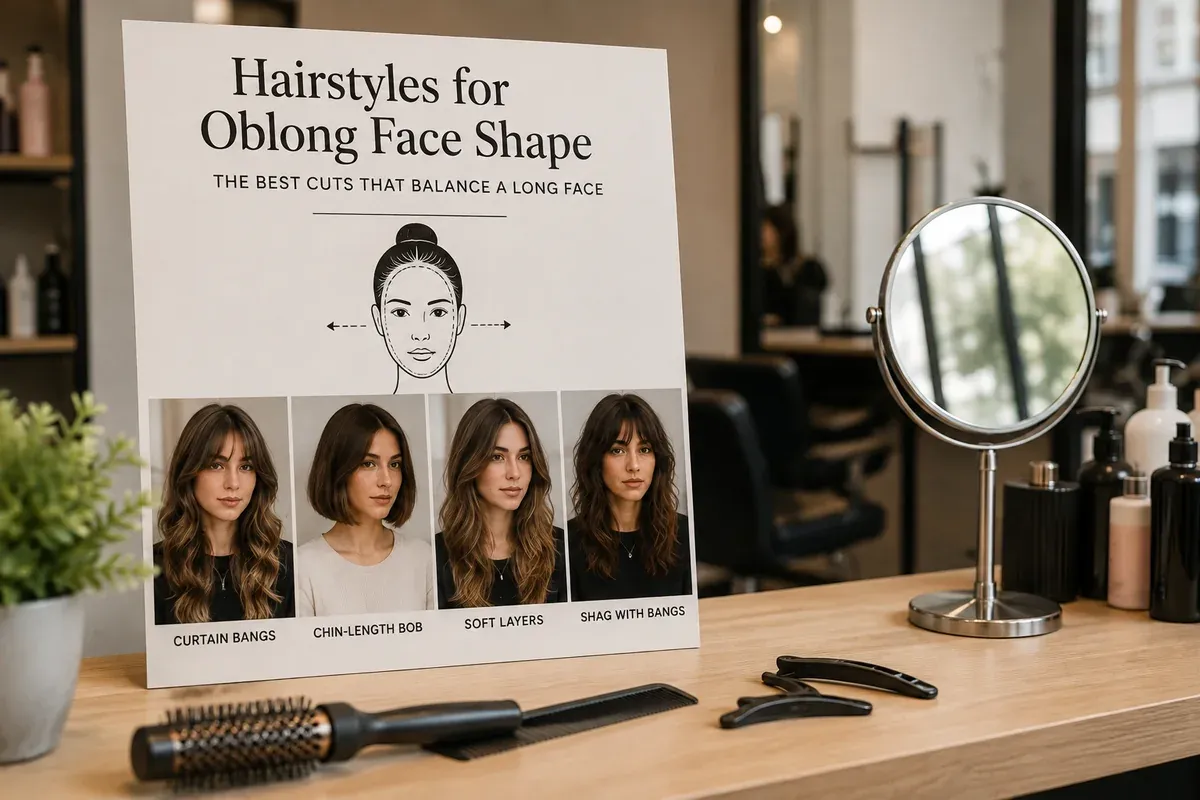
Hair covers more of a long face than anything else you wear, and it is the only element you can reshape at will. That makes it the most useful lever available if you want to balance oblong proportions, and the one where small decisions, such as where a layer falls, matter more than the name of the cut.
The short answer: build width at cheekbone or jaw level and shorten the forehead. Curtain bangs, chin-length bobs, shags and face-framing layers all do this. Long unlayered hair with a centre part, sleek high ponytails and volume concentrated at the crown all pull in the other direction.
What Does an Oblong Face Mean for Your Hair?
An oblong face is longer relative to its width than other shapes, and its forehead, cheekbones and jaw measure close to one another. There is no strong widest point and no dramatic taper. If you are not sure whether that describes your face, the face shape detector on the homepage scores all seven shapes from a photo or four measurements and shows the numbers it used.
Two things follow from that.
The forehead usually accounts for a large share of the total length, so anything that covers part of it has an outsized effect. And because there is no natural widest point, whichever part of your hair carries the most volume becomes the widest point by default. You get to choose where that is.
The Three Hair Decisions That Balance an Oblong Face
Almost every good hairstyle recommendation for an oblong face comes down to one of three decisions: the fringe, the layers and the volume placement.
The fringe. Covering part of the forehead shortens the face directly. This is the single biggest change available and the fastest to make.
The layers. Layers determine where the hair sits away from the head. Layers that begin at cheekbone or jaw level create width at the middle of the face. Layers that begin below the shoulders create width below the face, where it does nothing for proportion.
The volume placement. Height at the crown extends the vertical line. Volume at the sides interrupts it. The same amount of hair reads very differently depending on where it sits.
Which Haircuts Suit an Oblong Face on Women?
Seven styles suit an oblong face on women: curtain bangs, a full fringe, a chin-length bob, a mid-length cut with face-framing layers, a shag, waves at cheekbone level and a low updo.
Curtain Bangs
Curtain bangs are the most forgiving fringe for an oblong face. Curtain bangs part in the middle and sweep outward, so they cover the sides of the forehead while leaving the centre open. That combination shortens the forehead without the commitment of a full fringe, and the outward sweep adds width at the temples at the same time.
They also grow out gracefully, which matters if you are trying bangs for the first time. Cut so the shortest point sits around the eyebrow and the longest point reaches the cheekbone.
A Soft or Blunt Full Fringe
A full fringe has the strongest shortening effect of any cut on this list, because it draws a hard horizontal line across the forehead. A blunt fringe makes that line as strong as possible; a wispy or lightly textured fringe softens it while keeping most of the effect.
The length is what does the work. A fringe cut above the brow leaves more forehead visible and shortens the face less. Sitting at or just below the eyebrow gives you the most balance.
Chin-Length Bob
A bob that ends at or just below the chin places the heaviest part of the hair at the jaw, which is precisely where an oblong face gains from added width. A blunt bob creates a strong horizontal edge at the bottom; a bob with a slight inward bend at the ends wraps toward the jaw and reads even wider.
Pairing a chin-length bob with a fringe is one of the most effective combinations for a long face, because you shorten the forehead and widen the jaw in the same cut.
Mid-Length Cut with Face-Framing Layers
If you would rather not go short, a mid-length cut works well provided the shortest face-framing pieces begin around the cheekbone. Those pieces cup the widest part of the face and pull the eye sideways. Layers that start at the collarbone leave the face itself unframed and have much less effect.
Shag and Curly Shag
A shag is built from short layers through the crown and around the face, which produces volume at the sides rather than the top. Combined with the fringe that usually comes with it, it addresses both the forehead and the width in one cut. It suits wavy and curly hair particularly well, since the natural texture supplies the volume without daily styling.
Waves at Cheekbone Level
Waves at cheekbone level are a finish rather than a cut, and an effective one for an oblong face. Waves that begin around the cheekbone push the hair outward at the middle of the face. Waves that begin at the ends leave the top two thirds flat, which does very little for proportion. When you curl, start the iron higher than feels natural.
Updos, with One Adjustment
Updos are not off limits for an oblong face, but the placement matters. A low bun or a low ponytail sitting at the nape keeps the silhouette from growing upward, and pulling a few pieces loose at the sides restores some width. A high sleek bun does the opposite on both counts.
Women’s Hairstyles for an Oblong Face Compared
| Style | Where the width sits | Fringe needed? | Best for |
|---|---|---|---|
| Curtain bangs with any length | Temples and forehead | Yes, that is the style | A first fringe, easy grow-out |
| Chin-length bob | Jaw | Optional but strong | Straight or wavy hair, biggest change |
| Blunt fringe with mid length | Forehead | Yes | Straight hair, high-impact result |
| Mid-length with face-framing layers | Cheekbone | Optional | Keeping length, low commitment |
| Shag or curly shag | Crown sides and cheekbone | Usually included | Wavy and curly hair |
| Low updo with loose front pieces | Sides of the face | No | Formal occasions |
Which Hairstyles Lengthen an Oblong Face?
Six hairstyles lengthen an oblong face: long straight hair with a centre part, high sleek ponytails, volume at the crown, very short bangs, layers that start below the shoulders, and hair tucked behind both ears. None of these is an error, and many people wear them by choice; each one simply runs in the same direction the face already runs.
Long hair worn straight with a centre part. The centre part draws a vertical line down the middle of the face, and unlayered length adds vertical line on both sides of it. Together they emphasise length more than any other combination. A side part and some layers change it substantially without losing the length.
High sleek ponytails and top knots. Pulling the hair up and back adds height above the head and removes width beside the face at the same time. A lower placement solves most of it.
Volume concentrated at the crown. Root lift at the top of the head extends the vertical line. If you like volume, build it at the sides and through the mid-lengths instead.
Bangs cut very short. A micro fringe leaves most of the forehead visible while still committing you to bangs, so you take on the maintenance without the shortening effect.
Very long layers that start below the shoulders. These add width where there is no face to balance. Moving the shortest layer up to cheekbone level is often the only change a cut needs.
Hair tucked behind both ears. It removes the width beside the face entirely. Tucking one side only keeps some asymmetry and reads better.
How to Ask a Stylist for a Cut That Suits an Oblong Face
Style names travel badly between salons. Describing where you want the weight to sit gets a more reliable result than naming a cut.
- Say what you want the shape to do. Tell them you want the widest point of the cut at cheekbone or jaw level, and that you want to avoid height at the crown. That one sentence gives a stylist everything they need.
- Name the length in relation to your face. Rather than asking for a bob, ask for a bob that ends at the chin. Rather than asking for layers, ask for the shortest layer to fall at your cheekbone.
- Be specific about the fringe. Say where you want it to sit, using your eyebrow as the reference point. Ask for it to be cut dry if your hair has any wave, since wet hair drops and curly hair springs up.
- Discuss the part before they cut. Layers are cut relative to a part. If you plan to wear a side part, ask them to cut it on the side part rather than moving it afterwards.
- Ask what the cut looks like without styling. If a shape only works with a round brush and thirty minutes, it is worth knowing that before you commit.
- Have it dried and finished in the salon. Seeing the silhouette dry is the only way to know whether the width landed where you asked for it.
How to Style Hair for Width Without Cutting It
If you are not ready to change the cut, styling alone gets you a reasonable distance.
- Rough dry to about eighty percent, tipping your head from side to side rather than forward. Directing air across the head builds lateral volume; directing it down builds none.
- Set the part off-centre. Even an inch away from the middle breaks the vertical line.
- Curl or wave from cheekbone height rather than from the ears down, and alternate the direction of the curls so the shape stays irregular.
- Break up the curls with your fingers rather than a brush. Separated pieces read as width; a smooth uniform curtain reads as a vertical line.
- Finish with a texture spray at the mid-lengths, not at the roots. Root products lift upward, which is the direction you are trying to avoid.
How Hair Texture and Density Change the Best Cut
Fine straight hair benefits most from a blunt cut, since blunt ends read as fuller and hold a horizontal line. Heavy layering can leave it looking thin and vertical.
Thick straight hair needs internal weight removed so it does not sit as a solid block, but keep the perimeter blunt so the width at the ends survives.
Wavy hair is well matched to a shag or a mid-length with face-framing layers, because the wave supplies the outward movement on its own.
Curly hair grows outward already, which is an advantage. A curly shag or a curly bob cut at chin length uses the natural volume rather than fighting it. Cutting curly hair dry, curl by curl, gives you far more control over where the width lands.
How to Grow Out a Fringe on an Oblong Face
The awkward stage of growing out bangs is the point where they sit too long to be a fringe and too short to blend. For an oblong face that stage is worth managing rather than enduring, because a half-grown fringe pushed to one side still shortens the forehead if you place it well.
Once the ends reach the cheekbone, ask for them to be shaped into a curtain rather than trimmed straight. That converts the grow-out into a style in its own right, and the outward sweep keeps width at the temples while the length catches up with the rest of the cut. A deep side part during the same period hides the shortest pieces and keeps a diagonal across the forehead.
Pins and clips pull the front back and reopen the forehead, so use them sparingly during a grow-out. Tucking the shortest pieces into a low twist at one side keeps the front covered while it grows.
How Hair Colour Placement Supports an Oblong Face
Colour placement is a smaller lever than cut, but it points in the same direction. Lighter pieces around the face at cheekbone level draw the eye outward and sideways. A single flat colour from root to tip does nothing to break up length, and a dark shade with a bright vertical stripe at the front can reinforce it.
Softer, less contrasted placement around the face tends to be more flattering here than a high-contrast face-frame, since strong vertical stripes can read as another long line.
How Hair Works With Glasses and Makeup
Frames sit at eye level and create the strongest horizontal line on your face, which makes them a genuine partner to your haircut rather than a separate decision. See glasses for women with an oblong face and sunglasses for women with an oblong face.
Blush and bronzer placement follows the same principle, working across the face rather than up and down it. Our guide to makeup for an oblong face covers where each product goes and why.
Avoid running every one of these at maximum at once. A heavy blunt fringe, thick frames and strong contouring together can crowd the face. Choosing two to lead usually looks better than three competing.
Are These Hairstyle Rules Mandatory for an Oblong Face?
No. These hairstyle guidelines describe proportion, not corrections. An oblong face is an ordinary face shape and nothing here suggests it needs fixing. If you love long straight hair with a centre part, wear it; a style you feel good in reads better than a balanced one you are unsure about.
Face shape is also just one factor among many. Hair texture, density, how your hair grows, how much time you want to spend on it and what suits your life all count for as much. Use this to understand why a cut sits the way it does on you, then decide for yourself.
If you are still not sure your face is oblong, the detector on the homepage scores all seven shapes and shows the measurements behind the answer.
Frequently Asked Questions
Short answers to the questions that come up most often on this topic.
What haircut suits an oblong face shape on a woman?
Do bangs suit a long face?
Should women with oblong faces avoid long hair?
Is a centre part bad for an oblong face?
Can an oblong face wear a pixie cut?