Eyewear
Sunglasses for Men With an Oblong Face Shape
Sunglasses that suit an oblong face on men: wayfarers, clubmasters, squares and navigators, plus sizing, lens choice and the shapes to approach with care.
By Ayla Willow ·
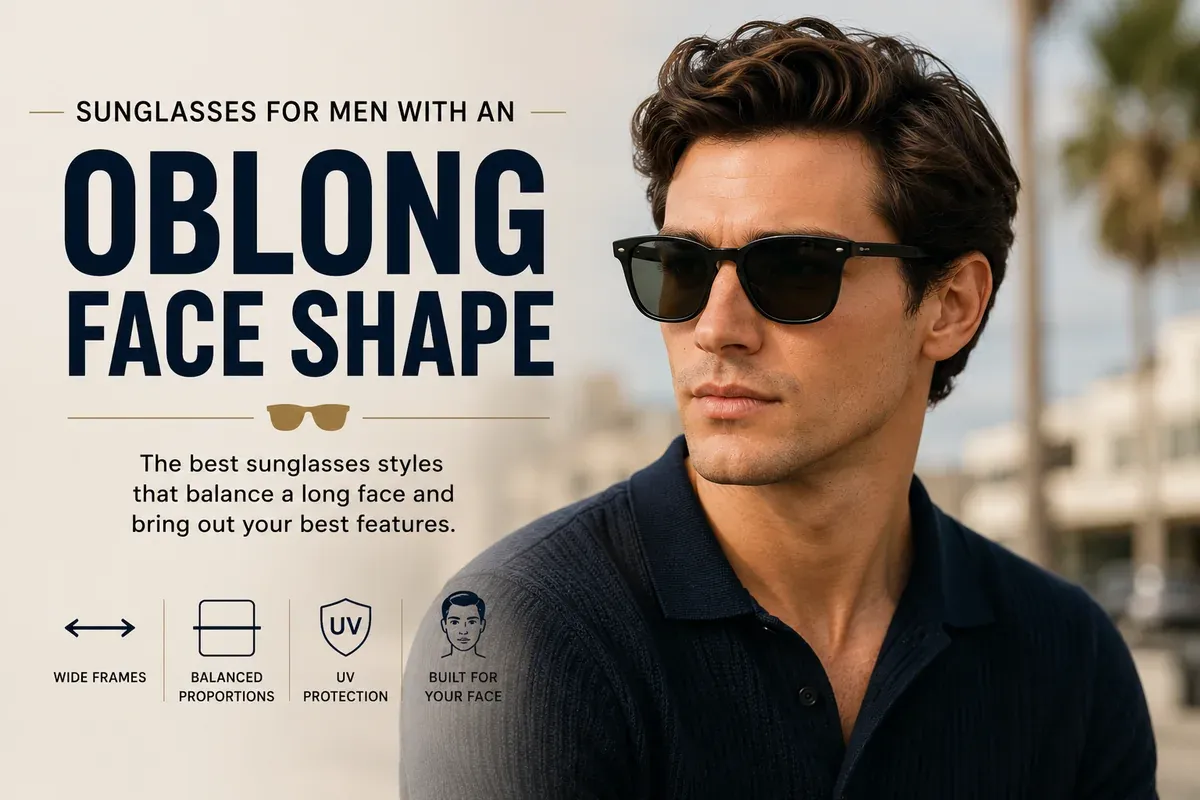
Sunglasses are usually larger than prescription frames, which means they cover more of the face and have more influence on how its proportions read. On an oblong face that scale is an advantage: there is more frame to work with and more of the mid-face to cover.
The short answer: go wide and reasonably deep, with a strong top line. Wayfarers, clubmasters, squared navigators and large square frames all suit a long face. Narrow frames, slim rimless styles and teardrop aviators do the least.
How Do Sunglasses Differ From Prescription Glasses on an Oblong Face?
Sunglasses follow the same principle as prescription glasses. An oblong face has more length than width, with the forehead, cheekbones and jaw measuring close to one another. A frame that draws a strong horizontal line across the middle interrupts that length, and a deep lens covers more of the mid-face. If you want to check where your own measurements land, the face shape detector on the homepage scores all seven shapes.
Two things are different in practice.
Sunglasses are usually bigger, so it is easier to find a frame that spans your full face width. The risk shifts from too small to too much: an oversized frame on a long but narrow face can look like it belongs to someone else.
Tint also changes the effect. A dark lens reads as a solid block of colour, which makes the frame area more visible than a clear lens does. That strengthens the horizontal, which is useful here, and it is why a dark wayfarer has more effect on your proportions than a clear frame of the same shape.
Which Sunglasses Shapes Suit an Oblong Face on Men?
Six sunglasses shapes suit an oblong face on men: wayfarers, clubmasters, large squares, navigators, oversized squared aviators and large round frames.
Wayfarer
A wayfarer is the most reliable sunglasses shape for an oblong face. A wayfarer has a thick, flat top line, a squared lens with real depth, and a width that suits most faces. Every one of those features works in your favour on a long face.
It is also easy to buy well. The shape has been made at every price point for decades, so finding a size that fits your face is a matter of checking measurements rather than searching for the shape.
Clubmaster and Browline Sunglasses
A clubmaster puts a heavy brow across the top and leaves the lower half light or rimless. All the visual weight sits along one horizontal line at brow height, which is the most useful place to put it. It reads more formal than a wayfarer without being heavier overall.
Square and Oversized Square Frames
Where a wayfarer balances width and depth, a large square prioritises coverage. It fills more of the mid-face, which shortens the visible distance from brow to cheek. This suits men with larger features, and it is the shape to try if slimmer frames tend to disappear on you.
Navigator
A navigator is a squared take on the aviator: a flat or almost flat top bar with a lens that stays wide toward the bottom rather than tapering. The bar supplies the horizontal, and the typical size means the frame spans a good part of the face. It is a good middle ground if a wayfarer feels too blocky and an aviator feels too soft.
Oversized Aviators, with a Condition
Aviators work on an oblong face when they are large and squared off at the bottom. A big lens covers plenty of mid-face and the double bridge adds a horizontal element at the top.
What does not help is the classic teardrop: a lens that narrows toward a point at the lower outer corner draws the eye downward, in the same direction the face already runs. If you like the aviator look, choose the squarer version.
Round Frames, at Size
Round sunglasses put their widest point level with the eye and contrast with a long, straight face. Like round prescription frames, they need to be reasonably large to span enough of the face. Small round lenses sit in the middle of a long face without doing much.
Sunglasses Shapes for an Oblong Face Compared
| Shape | Top line | Lens depth | Reads as | Best for |
|---|---|---|---|---|
| Wayfarer | Thick and flat | Medium to deep | Casual, familiar | Everyday wear, most sizes |
| Clubmaster | Heavy brow only | Medium | Smarter, structured | Balance without bulk |
| Large square | Straight, substantial | Deep | Bold, covering | Larger features |
| Navigator | Flat top bar | Medium to deep | Relaxed, outdoors | Middle ground between styles |
| Oversized squared aviator | Double bridge | Deep | Classic, larger scale | Aviator look with more balance |
| Large round | Curved | Medium to deep | Distinctive | Contrast with a long straight face |
What Size Sunglasses Suit an Oblong Face?
Sunglasses print the same three numbers as prescription frames on the inside of the temple arm, usually as something like 54-18-145.
- Lens width is the first number in millimetres. Bigger means more horizontal coverage.
- Bridge width is the second, the gap between lenses. It affects fit and how high the frame sits.
- Temple length is the third, affecting only how the arms sit behind your ears.
- Lens height is not usually printed, so measure it with a ruler. Around 40mm or more keeps a frame from reading as a band on a long face.
- Total width is what matters most for proportion. Measure your own face at the temples with a soft tape, then match that figure or exceed it a little.
The usual test in a mirror is simpler: the frame should reach roughly to the outer edge of your face, and your cheeks should not be visible on either side of the lenses when you look straight on.
How Lens Colour and Finish Change the Effect
Lens choice is mostly about function, but it has a small effect on appearance.
Dark solid tints in grey, green or brown make the lens area read as a defined block, which reinforces the horizontal line. Very light or gradient tints let more of your eye show through, which softens the effect.
Mirrored lenses read as a solid surface too, so they behave like a dark tint in terms of proportion. Whether you want that level of visual weight is a style choice rather than a proportion one.
The functional point is more important than any of this. Look for UV400, or a clear statement of 100 percent UVA and UVB protection, on the label. Tint darkness and UV protection are separate things: a dark lens without UV filtering is worse than no sunglasses at all, because your pupils open wider behind it.
Should Sunglasses Be Polarised?
Polarisation is a separate decision from shape, and it does not affect proportion at all, but it comes up on every product page so it is worth being clear about.
A polarised lens filters horizontally reflected light, which cuts glare bouncing off water, wet roads and car bonnets. If you drive a lot, spend time on the water or ski, it is a genuine improvement in comfort rather than a marketing feature.
The trade-off is that polarised lenses interact with LCD screens. Dashboard displays, phone screens and some instrument panels can look dark or patterned at certain angles. It is not a safety issue for most people, but it is worth knowing before you buy a pair for driving.
Polarisation and UV protection are also separate specifications. A lens can be polarised without full UV filtering, so check for UV400 regardless.
Which Sunglasses Lengthen an Oblong Face?
Narrow frames, slim shallow rectangles, rimless styles, teardrop aviators, small round lenses and very tall narrow frames do the least for an oblong face. None of these is a mistake; each one just does less, or runs in the same direction as the face.
Narrow frames. Anything noticeably narrower than your face leaves cheek visible at the sides and concentrates the frame in the centre, which lengthens the look.
Slim, shallow rectangles. Low-profile sunglasses with a very shallow lens read as a thin stripe across a long face. Depth is usually the missing ingredient.
Rimless and thin wire styles. They add almost no horizontal line. If you want the frame to work with your proportions, these are the least effective option.
Classic teardrop aviators. The downward taper points the same way the face runs.
Small round lenses. Round works at size, but a small circle can look isolated.
Very tall frames on a narrow face. Oversized is useful, but a frame that is both very deep and very narrow adds vertical rather than horizontal, which is the opposite of the goal.
How to Try On Sunglasses for an Oblong Face
- Look straight on first. Check that the frame spans your full face width and that you cannot see cheek at either side of the lenses.
- Check the brow line. Your eyebrows should sit at or just behind the top of the frame rather than well above it.
- Look down. If the frame slides, the bridge is too wide for your nose regardless of how the shape looks.
- Check the profile. The lens should sit close to your face without touching your lashes, and the arms should follow the side of your head.
- Step outside if you can. Tint reads very differently under shop lighting than in daylight.
- Try one size up and one size down. Sizing varies between brands, and the same style number can fit differently.
How Sunglasses Work With a Haircut and a Beard
Sunglasses sit on the same face as everything else, and they work best when the rest agrees with them.
A cut with a fringe shortens the forehead just above the frame, reinforcing the same effect. See hairstyles for men with an oblong face.
Facial hair squared off at the jaw adds width at the bottom of the face to balance the frame at the top. Beard styles for an oblong face covers the shapes that work.
If you wear a prescription too, the same principles apply at a smaller scale in glasses for men with an oblong face.
Running all three at maximum strength can crowd the face. Large sunglasses, a heavy fringe and a full beard together is a lot at once; letting two lead usually reads better.
Are These Sunglasses Rules Mandatory for an Oblong Face?
No. These sunglasses guidelines describe proportion, not corrections. An oblong face is an ordinary face shape and nothing here suggests otherwise. Sunglasses also have a job to do beyond appearance, and protection, comfort and coverage matter more than shape.
If a pair you love breaks every guideline above, wear it. How comfortable you look in something reads more clearly than proportion. Use this to understand why one pair works better on you than another, then decide for yourself.
Frequently Asked Questions
Short answers to the questions that come up most often on this topic.
What sunglasses suit a man with a long face?
Do aviators suit an oblong face?
Should sunglasses be wider than your face?
Are wraparound sports sunglasses a good choice?
What should I check on the label before buying?